At first glance, The Great Flood looks like a familiar end-of-the-world thriller — collapsing buildings, rising waters, and ordinary people scrambling to survive. But just when you settle into that expectation, the Korean film takes a sharp left turn. What begins as a flood apocalypse in Seoul slowly reveals itself as something far stranger, darker, and more unsettling.
Streaming on Netflix, the film isn’t always smooth in its storytelling, but it remains intriguing enough to keep you watching — especially once its true intentions come into focus.
Storyline: From Flood Survival to Something More Sinister
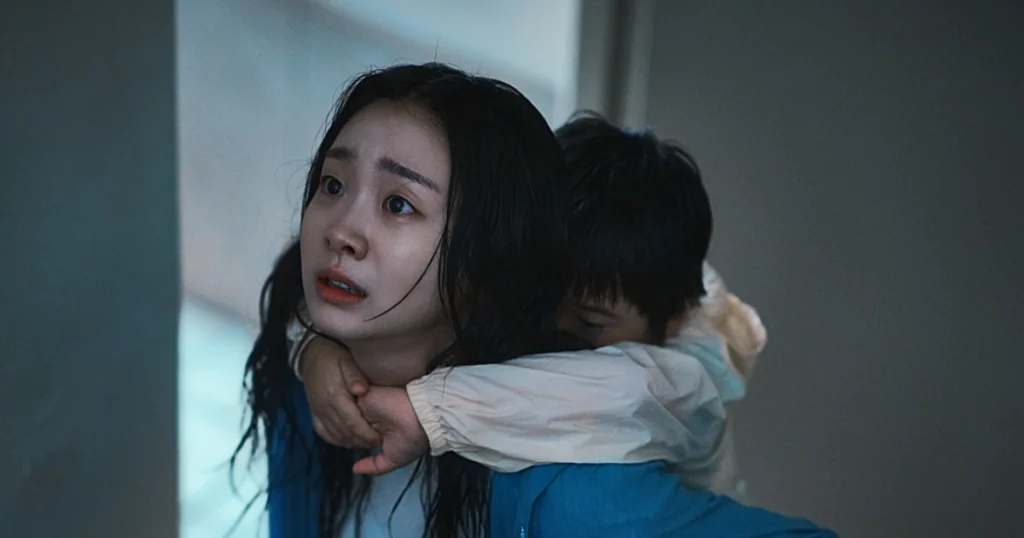
The story follows An-na, a single mother trying to escape a catastrophic flood with her six-year-old son, Ja-in. As water levels rise through their high-rise apartment complex, survival feels brutally straightforward — climb higher or drown.
Early on, the film toys with ideas of class and access as residents fight their way up the building. But the narrative shifts dramatically when An-na’s identity is revealed: she isn’t just another civilian. She’s a key scientist tied to a secret global research project, one considered vital for humanity’s future.
A corporate security officer explains that an asteroid impact in Antarctica has triggered the floods — and that An-na and her son are being evacuated, not saved randomly. From this point, The Great Flood abandons pure disaster storytelling and slides into layered sci-fi territory, where reality, memory, and choice begin to loop in unsettling ways.
Cast & Performances
Kim Da-mi delivers a restrained but effective performance as An-na, balancing maternal instinct with quiet emotional detachment. Her character’s gradual emotional “correction” becomes a key thematic element rather than just character growth.
Young Kwon Eun-seong, playing Ja-in, brings a natural innocence that contrasts sharply with the film’s increasingly artificial and controlled environment. Park Hae-soo’s corporate security officer adds unease rather than comfort — a presence that feels more managerial than heroic.
What Worked
- Genre Shift: The film’s pivot from disaster survival to conceptual sci-fi is bold and genuinely surprising.
- Atmosphere: Flood imagery, rooftop ascents, and looming waves create a consistent sense of dread.
- Ideas Over Spectacle: The film is more interested in systems, choices, and emotional programming than just destruction.
There are clear influences here — echoes of Interstellar, Edge of Tomorrow, and even Charlie Kaufman-style narrative loops — but they’re filtered through a distinctly Korean lens.
What Didn’t Work
- Brittle Storytelling: The narrative often feels stiff, especially when it comes to emotional stakes.
- Weak Antagonistic Force: The film never fully commits to defining what — or who — we’re meant to fear most.
- Emotional Distance: Some moments feel intentionally calibrated rather than genuinely felt, which may frustrate viewers looking for raw human drama.
Ironically, these weaknesses also reinforce the film’s central idea — that human emotion itself is being optimized, corrected, and shaped.
Final Verdict
The Great Flood isn’t a traditional disaster movie, and it’s not a clean sci-fi thriller either. It’s something in between — a film that questions not just humanity’s survival, but how stories themselves may be engineered in the future.
It stumbles in execution, but its ambition and unsettling subtext make it worth watching. If you’re open to a disaster film that slowly reveals a darker, algorithm-driven soul, The Great Flood offers a quietly disturbing experience rather than easy thrills.
Streaming on Netflix from December 19