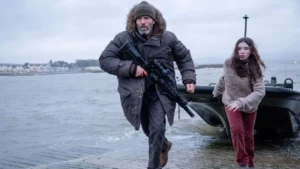
Steven Spielberg has spent nearly fifty years asking audiences to look up at the sky and wonder what might be waiting there. From the childlike awe of E.T. the Extra-Terrestrial to the cosmic obsession of Close Encounters of the Third Kind, his films have often suggested that humanity becomes its best self when confronted by the unknown. With Disclosure Day, Spielberg revisits those lifelong fascinations, but through a lens shaped by modern anxieties.
At first glance, the filmmaker’s latest blockbuster looks like an old-school conspiracy thriller. It has government secrets, relentless chases, shadowy organizations, and ordinary people caught in extraordinary circumstances. But beneath its pulse-pounding exterior lies something much more ambitious. This isn’t simply a movie about aliens, cover-ups, or impending catastrophe. It’s a deeply emotional plea for empathy, truth, and human connection in an age drowning in misinformation.
The result is one of Spielberg’s richest films in years — a spectacular summer blockbuster that entertains while quietly challenging audiences to reconsider what they believe and why.
Spielberg Blends 1970s Paranoia With Cosmic Wonder
The DNA of Disclosure Day feels unmistakably familiar.
There are echoes of paranoid classics like Three Days of the Condor and The Parallax View, films where institutions become increasingly impossible to trust. Spielberg channels that same creeping unease here, creating a world where whispers carry more weight than headlines and where the truth itself has become dangerous.
The story unfolds against the backdrop of a planet teetering on the edge of disaster. The threat of nuclear conflict lingers in distant news broadcasts, evoking memories of the Cuban Missile Crisis. Yet the geopolitical tensions gradually reveal themselves to be secondary to something far more profound.
At the center of the conspiracy is Dr. Daniel Kellner, played brilliantly by Josh O’Connor.
A former hacker with a criminal past, Kellner now works for Wardex, a secretive organization dedicated to protecting the government’s deepest mysteries surrounding Unidentified Anomalous Phenomena, or UAPs. After years of suppressing truths tied to extraterrestrial encounters dating back to Roswell, Kellner reaches his breaking point.
He steals the evidence.
And runs.
Joining him is Jane, portrayed by Eve Hewson, a former nun whose faith and emotional intelligence become increasingly important as the story evolves.
Pursuing them is Noah Scanlon, Wardex’s calculating leader played by Colin Firth. Convinced that revealing humanity’s greatest secret would trigger chaos, he believes censorship isn’t cruelty — it’s protection.
That moral complexity gives the film its heartbeat.
Emily Blunt Delivers a Career-Best Performance
If Josh O’Connor provides the story’s urgency, Emily Blunt gives it its soul.
Blunt stars as Margaret Fairchild, a Kansas City television weathercaster whose ordinary existence begins unraveling through a series of terrifying incidents. It starts subtly enough. A cardinal appears inexplicably at her window. Then she begins speaking fluent Russian without understanding how.
Later, during a live broadcast, she suddenly utters strange, otherworldly sounds before collapsing.
The episodes escalate.
One moment she’s conversing in perfect Korean. The next, she’s questioning her own sanity while her bewildered boyfriend Jackson, played by Wyatt Russell, struggles to comprehend what’s happening.
Margaret’s journey becomes the emotional core of Disclosure Day.
Blunt navigates fear, confusion, vulnerability, and resilience with astonishing precision. The role demands extraordinary versatility, requiring her to shift between languages, emotional states, and identities while maintaining the audience’s investment throughout.
It’s one of the finest performances of her career.
And in a film packed with remarkable work, she stands tallest.
Spielberg Knows Exactly When Not to Explain
One of Disclosure Day’s greatest strengths lies in its restraint.
Modern blockbusters often suffer from over-explaining themselves, sacrificing mystery in pursuit of clarity. Spielberg does the opposite. He trusts viewers to sit with uncertainty and allows discoveries to emerge organically.
The screenplay, written by longtime collaborator David Koepp from a story by Spielberg himself, carefully reveals information without disrupting momentum.
As Margaret and Kellner’s seemingly separate stories begin converging, the film transforms into something both intimate and expansive.
It’s a road movie.
A chase thriller.
A science-fiction mystery.
A spiritual meditation.
Saying much more about its twists would genuinely diminish the experience.
Part of the joy comes from surrendering to Spielberg’s storytelling instincts and allowing the narrative to unfold on its own terms.
The less you know going in, the more rewarding the journey becomes.
The Supporting Cast Elevates Every Scene
While Blunt and O’Connor anchor the film, the supporting ensemble ensures there isn’t a weak link anywhere.
Colman Domingo brings profound warmth and gravitas as Hugo Wakefield, a former Wardex loyalist who now understands the true stakes of humanity’s choices. Hugo emerges as the story’s moral compass, guiding the protagonists toward a destiny larger than themselves.
Domingo plays him with such compassion that even the smallest moments resonate deeply.
Eve Hewson also shines as Jane.
Rather than functioning as a passive companion, Jane introduces spiritual and philosophical dimensions that prevent the film from becoming purely procedural. She challenges assumptions and anchors the story’s growing belief in empathy over fear.
Meanwhile, Colin Firth resists the temptation to transform Noah Scanlon into a cartoon villain.
He plays him as a man convinced he’s saving civilization.
That’s what makes him unsettling.
He isn’t motivated by greed or malice.
He simply believes the truth would destroy us.
And perhaps that’s the film’s most haunting question.
Spielberg’s Craft Remains Untouchable
Few filmmakers orchestrate spectacle with Spielberg’s confidence.
Nearly every department operating here is working at the top of its game.
Janusz Kaminski’s cinematography balances intimacy with grandeur, capturing both the quiet vulnerability of private moments and the overwhelming scale of unfolding events.
Sarah Broshar’s editing keeps the two-hour-and-twenty-five-minute runtime remarkably fluid.
John Williams delivers another magnificent score, reminding audiences why his collaborations with Spielberg remain among cinema’s greatest partnerships. The music never overwhelms emotion. Instead, it amplifies wonder and tension in equal measure.
The visual effects serve the story rather than distracting from it.
One breathtaking sequence involving a car chase colliding with a moving train instantly earns its place among Spielberg’s most exhilarating action set pieces. Watching Emily Blunt and Josh O’Connor cling desperately to survival as steel crashes around them is pure blockbuster filmmaking at its finest.
It’s thrilling.
But it’s never empty.
What Worked and What Didn’t
What works most is Spielberg’s refusal to choose between entertainment and substance. The film functions beautifully as a suspense thriller while also exploring themes of truth, fear, faith, and compassion. Emily Blunt delivers career-defining work, Josh O’Connor is exceptional, and Colman Domingo brings emotional depth that lingers long after the credits roll.
The craftsmanship across every department is impeccable, and David Koepp’s screenplay elegantly balances mystery with emotional clarity.
If there’s any criticism, it’s that some viewers expecting straightforward extraterrestrial spectacle may find the film’s philosophical ambitions surprising. The spiritual themes grow increasingly prominent during the final act, demanding emotional investment alongside intellectual curiosity.
For some, that’s precisely what will make Disclosure Day extraordinary.
For others, it may require surrendering expectations of what a summer blockbuster usually delivers.
Final Verdict
In an era where franchise filmmaking often mistakes noise for meaning, Disclosure Day feels almost miraculous.
Steven Spielberg has crafted a movie that embraces excitement without sacrificing intelligence. It’s a thrilling conspiracy drama, a deeply human science-fiction story, and an earnest meditation on why truth still matters.
Most importantly, it reminds us that Spielberg’s greatest gift has never been spectacle.
It’s wonder.
His enduring belief that humanity can choose empathy over fear remains intact, even when the world around us seems increasingly determined to do the opposite.
Nearly fifty years after Close Encounters of the Third Kind, Spielberg is still asking audiences to look beyond themselves and imagine something greater.
The astonishing thing is that he can still make us believe.