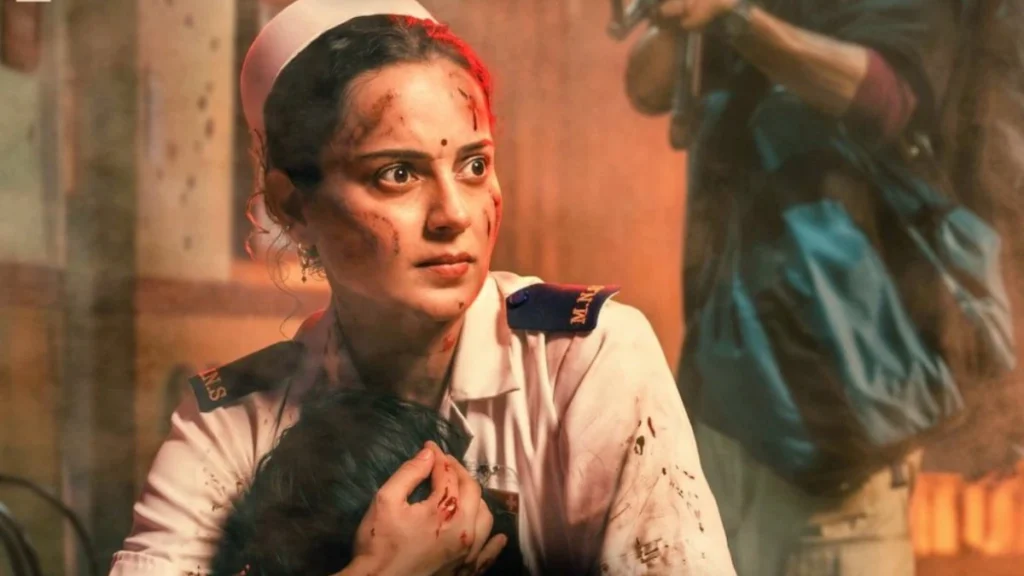
The 26/11 Mumbai terror attacks left behind stories of unimaginable fear, heartbreak and courage. While films have often focused on the police officers, commandos and terrorists involved in that horrific night, Bharat Bhhagya Viddhaata turns its attention toward a group of unsung heroes who rarely occupied the center of the conversation — the nurses, ward boys and hospital staff at Cama & Albless Hospital.
Directed by Manoj Tapadia and headlined by Kangana Ranaut, the film attempts to honor the ordinary people who performed extraordinary acts under impossible circumstances. It is a sincere, respectful and often moving tribute to those who chose duty over fear while protecting hundreds of vulnerable patients trapped inside a hospital under attack.
The problem is that while its heart is firmly in the right place, the film struggles to match its noble intentions with equally compelling storytelling. There are moments of genuine power scattered throughout its runtime, but inconsistency in writing and emotional development stops it from becoming the unforgettable experience it could have been.
A Night of Terror Seen Through the Eyes of Cama Hospital’s Caregivers
Unlike many 26/11 narratives that immediately throw audiences into the chaos, Bharat Bhhagya Viddhaata begins in the aftermath.
Geeta Gandhare, played by Kangana Ranaut, is called in for police questioning as the only witness capable of recounting what happened inside Cama Hospital during the attacks. Through her memories, the audience is transported back to the longest night of her life.
Before terror arrived, life inside the hospital moved with familiar routine.
Geeta and her fellow nurses dedicated themselves to caring for patients while juggling demanding shifts and personal responsibilities. They dreamed of improving lives, comforted frightened families and worked tirelessly despite receiving little recognition for their efforts.
Then normalcy shattered.
After completing a double shift, Geeta begins hearing unusual sounds outside. Initially dismissed as firecrackers, the noises soon reveal a horrifying reality. Terrorists have launched coordinated attacks across Mumbai, and Cama Hospital is directly in danger.
Suddenly, nurses including Trupti, Sheetal, Babita and Mohini find themselves confronting situations they were never trained to face.
Inside the hospital are more than 300 people.
Among them are pregnant women, newborn babies and critically ill patients who cannot escape on their own.
What unfolds next forms the emotional backbone of the film.
The Film Works Best When It Celebrates Collective Courage
One of Bharat Bhhagya Viddhaata’s greatest strengths is its refusal to turn heroism into spectacle.
The nurses aren’t portrayed as action heroes.
They’re frightened.
They’re exhausted.
And yet they continue moving forward.
The film shines brightest when it captures the quiet bravery of people who simply chose to do their jobs despite knowing the risks involved. Watching Geeta and Trupti protect infants in the NICU while chaos unfolds outside becomes infinitely more affecting because their actions aren’t presented as grand gestures.
They’re acts of humanity.
The attack sequences themselves generate considerable tension.
Manoj Tapadia stages several moments with enough urgency to remind viewers of the terror Mumbai experienced that night. Enhanced by an effective background score, these scenes create genuine anxiety as corridors transform into battlegrounds and every decision carries life-or-death consequences.
The film also deserves credit for spotlighting a chapter of 26/11 that remains relatively underrepresented in mainstream cinema.
The bravery of Cama Hospital’s staff deserves remembrance.
Bharat Bhhagya Viddhaata ensures audiences won’t easily forget their contributions.
The Emotional Foundation Feels Underdeveloped
Unfortunately, the film’s biggest weakness lies in its inability to fully flesh out the people at its center.
The first half spends considerable time introducing the nurses and their routines, but it never truly allows viewers inside their personal worlds. We learn that many are married. We understand their families often complain about their dedication to work.
But beyond those broad details, the characters remain frustratingly distant.
As a result, several emotional moments in the latter half don’t land with the force they deserve.
When tragedy strikes or sacrifices are made, audiences intellectually understand the gravity of what’s happening. Emotionally, however, the connection isn’t always as strong because the groundwork wasn’t sufficiently laid earlier.
The film often feels divided into two distinct experiences.
One half focuses on setup and camaraderie.
The other shifts toward survival and resilience.
Instead of flowing seamlessly into one another, they occasionally feel stitched together.
Following a genuinely effective interval point, expectations naturally rise.
Unfortunately, the second half struggles to consistently sustain both drama and emotional intensity.
Kangana Ranaut Leads With Conviction
Kangana Ranaut throws herself completely into Geeta Gandhare.
The actress has often thrived in roles requiring determination and emotional grit, and she brings both qualities here. Geeta emerges as compassionate yet practical, capable of vulnerability while refusing to abandon those depending on her.
Kangana commits wholeheartedly to the performance.
However, the characterization itself presents challenges.
Geeta is written as a Maharashtrian woman from Mumbai, but the consistency of that identity becomes uneven throughout the film. Her accent fluctuates noticeably, and certain dialogue deliveries weaken the authenticity the role demands.
It’s less a failure of effort and more a consequence of inconsistent execution.
Still, Kangana remains one of the film’s strongest assets.
Among the supporting cast, Smita Tambe is exceptional.
As Trupti, she delivers some of the movie’s most emotionally grounded moments without ever chasing dramatic excess. Rasika Agashe also leaves a strong impression, balancing tenderness with resilience.
Girija Oak Godbole and Esha Dey contribute distinct personalities that prevent the ensemble from blending together, while Prasad Oak makes the most of limited screen time as Geeta’s husband.
The terrorists themselves, played by Zahid and Aditya Mishra as Ajmal Kasab and Abu Ismail, remain largely underexplored.
Given the narrative focus on the hospital staff, this may have been intentional. Even so, viewers anticipating a deeper examination of the attackers’ presence may find themselves surprised by how little emphasis is placed on them.
What Worked and What Didn’t
What worked most is the film’s intention.
Bharat Bhhagya Viddhaata succeeds in reminding audiences that heroism often wears ordinary uniforms. The camaraderie between the women feels authentic, particularly during quieter scenes where they laugh together, tease one another and briefly forget the burdens they carry.
The attack sequences are tense and respectfully handled, while the performances from Smita Tambe and Kangana Ranaut anchor the narrative.
What doesn’t work quite as well is the inconsistency running throughout the screenplay. The emotional arcs feel underdeveloped, language choices occasionally weaken immersion, and the film struggles to maintain momentum after a promising interval.
For a story carrying immense emotional weight, there are too many moments where viewers admire what’s unfolding rather than deeply feeling it.
The intention deserves applause.
The execution, however, doesn’t always rise to meet it.
Final Verdict
At 2 hours and 10 minutes, Bharat Bhhagya Viddhaata justifies its existence by shedding light on a forgotten chapter of one of India’s darkest nights. It honors healthcare workers who placed the safety of strangers above their own survival and ensures their courage receives the recognition it deserves.
As cinema, it remains uneven.
As a tribute, it is heartfelt.
The film may not consistently deliver the emotional knockout it reaches for, but its sincerity is difficult to dismiss. Despite its flaws, it succeeds in preserving the memory of women who stood tall when fear threatened to consume everything around them.
And perhaps, in stories like these, remembrance itself becomes a form of victory.
What Worked / What Didn’t
What Worked: Strong intentions, respectful storytelling, effective tension during attack sequences, heartfelt performances from Kangana Ranaut, Smita Tambe and Rasika Agashe, and a much-needed spotlight on Cama Hospital’s unsung heroes.
What Didn’t: Inconsistent screenplay, underwritten personal arcs, uneven accents and dialogue delivery, emotional moments that don’t always fully resonate, and a second half that struggles to maintain the momentum built before the interval.