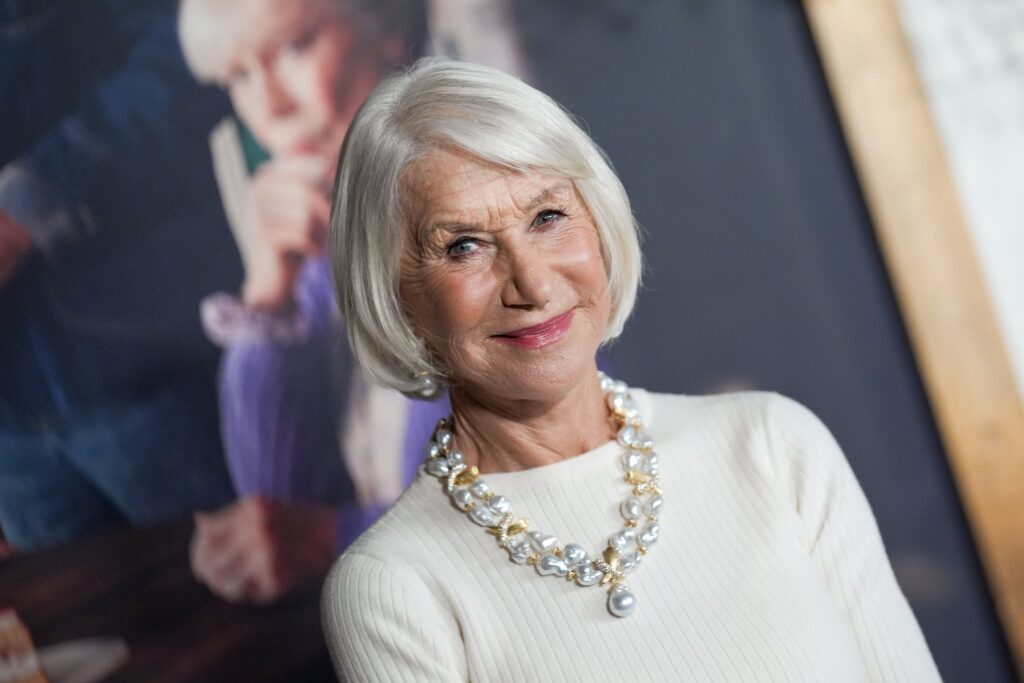
Helen Mirren has never been an actress who avoids difficult conversations. Even while receiving a Lifetime Achievement Award at the Taormina Film Festival, the Oscar-winning star found herself addressing subjects far more complex than career milestones and red carpets. From the rise of anti-Semitism to Israel’s military actions in Gaza, Mirren offered deeply personal reflections shaped by decades of experience, historical memory, and emotional ties to a country she says she once viewed with unwavering idealism.
The actress also broke her silence on a disturbing incident from last year, when a pro-Palestinian activist verbally confronted her in London over her connections to Israel. Rather than responding with anger, Mirren attempted to understand what might have driven such hostility while also making it clear that her criticism of Israel’s government does not diminish her affection for many of the people who live there.
The result was one of the most nuanced and emotionally layered conversations to emerge from this year’s festival circuit.
Helen Mirren Speaks About the London Incident Being Investigated as a Hate Crime
The discussion began when Mirren was asked about an encounter in London last year that remains under investigation as a hate crime.
The actress had reportedly been called an “evil Zionist” by a pro-Palestinian activist because of her well-known ties to Israel. Reflecting on the confrontation, Mirren appeared more puzzled than outraged.
“I don’t know whether he read things on the Internet or thought he read something which he hadn’t read, I don’t know,” she said.
She went on to suggest that the individual may have been “either over passionate or maybe mentally not quite stable.”
Rather than escalating the rhetoric, Mirren’s comments carried an air of sadness about how quickly assumptions can replace understanding in today’s increasingly polarized environment.
The incident attracted attention partly because Mirren’s relationship with Israel has always been more complicated than simple political labels allow.
Why Israel Holds a Deep Personal Meaning for Mirren
Long before she portrayed Israeli Prime Minister Golda Meir on screen, Israel had already become part of Mirren’s life story.
The actress first visited the country in 1967, shortly after the Six-Day War, while accompanying her then-boyfriend. During that trip, she worked at Kibbutz Ha’on near the Golan Heights and experienced Israeli society from within.
Her connection was also shaped by the generation into which she was born.
“I was born at the end of the Second World War,” Mirren said.
“The realisation in my parents’ generation of what had happened in the Holocaust was so profound, so important and therefore to me the creation of Israel was a very important moment.”
For many who grew up in the immediate aftermath of World War II, the establishment of Israel represented hope following unimaginable horror.
Mirren acknowledged that understanding while also questioning aspects of how history unfolded.
“Although maybe it was done in the wrong way, in the wrong place, I don’t know, but something had to happen after the horror.”
She added with characteristic self-awareness, “I have many Jewish friends, as we say.”
“My first two boyfriends were Jewish. A French Jewish boyfriend and an English Jewish boyfriend.”
The remarks offered insight into why discussions surrounding Israel resonate with such personal complexity for her.
Mirren Condemns Israel’s Actions in Gaza
While speaking warmly about Israeli friends and intellectual communities, Mirren did not shy away from criticizing the country’s leadership.
In fact, some of her strongest comments were directed toward Israel’s recent military campaign in Gaza.
“The evil forces, they arise everywhere, don’t they? Even in a country like Israel where you think, ‘My God, this is what happened to you as a people. How can you possibly repeat the actions of what was done to you as a people to another people?’ Crimes against humanity, it’s called,” she said.
At the same time, Mirren resisted broad generalizations about Israeli society.
“I have such great friends in Israel. The artistic community in Israel, the intellectual community in Israel are such remarkable people.”
For Mirren, criticizing a government’s actions and valuing the humanity of its citizens are not mutually exclusive positions.
She appeared deeply troubled by what she sees as a painful contradiction.
“I always thought, Israel is a country that will never do wrong,” she later admitted.
“But, of course, they were doing wrong even then.”
Her reflections revealed disappointment rooted not in indifference, but in affection and shattered expectations.
The Rise of Anti-Semitism Concerns Her Deeply
Mirren also acknowledged growing concerns over anti-Semitism following the October 7, 2023 Hamas attacks and the devastating war that followed.
“The rise of anti Semitism is so easy,” she said.
At the same time, she argued that the Israeli government’s actions have had damaging consequences beyond the immediate conflict.
“What the government in Israel has done is so destructive to Israel and to our understanding and our potential love for Israel. It’s so awful, so destructive.”
Her comments attempted to navigate a difficult space that public figures increasingly struggle to occupy.
Support for Jewish communities does not automatically equate to endorsement of government policies.
Criticism of military actions should not become justification for anti-Semitism.
Mirren’s perspective sought to hold both realities at once, even if doing so invites criticism from multiple sides.
History’s Heroes and the Brutality Behind Greatness
One of the most thought-provoking moments came when Mirren broadened the conversation beyond modern geopolitics.
Drawing on historical figures she has portrayed and studied throughout her career, she questioned society’s tendency to celebrate conquest.
“You know, when you play Catherine the Great, why was Catherine called the Great?” she asked.
“Because she took land.”
“She was Putin.”
She continued by referencing other figures immortalized by history.
“Why was Alexander the Great called Alexander the Great? Why? Because he took land. He invaded, he killed people, he destroyed cities, he took land.”
“Genghis Khan. Why is he remembered in history? Because with incredible brutality and unbelievable cruelty, he took land.”
The actress suggested that humanity repeatedly glorifies expansion and violence under the banner of greatness.
“And so, it devastates me,” she said.
“The evil is always lurking, waiting to take over, even in a place like Israel.”
It was less a political argument than a reflection on recurring human patterns that transcend borders and centuries.
Looking Ahead: MobLand and Her Admiration for Tom Hardy
Away from politics, Mirren also touched on another topic dominating entertainment headlines: uncertainty surrounding Tom Hardy’s future in MobLand.
The actress made it clear she hopes Hardy returns.
“I love Tom. I think he’s the most amazing actor,” she said.
“I’ve always loved him on screen.”
“He’s got the kindest heart… I think he’s absolutely remarkable. So my support of him is genuine and heartfelt.”
Asked whether she expected him to return, Mirren remained optimistic.
“We also have a very great writer, Jez Butterworth, a powerful, fantastic writer. So I really hope it’s going to happen.”
“When you have these sort of very powerful artistic people working together, the creative process is very challenging and people can get their knickers in a twist, as we say.”
“But yes, we will go forward, absolutely, and it’ll be even better.”
As Mirren accepted her Lifetime Achievement Award beneath the backdrop of Taormina’s ancient amphitheater, she reminded audiences why she remains one of cinema’s most respected voices.
Even in a world increasingly divided by certainty and outrage, she still embraces complexity.
And perhaps that’s what made her remarks resonate long after the applause faded.