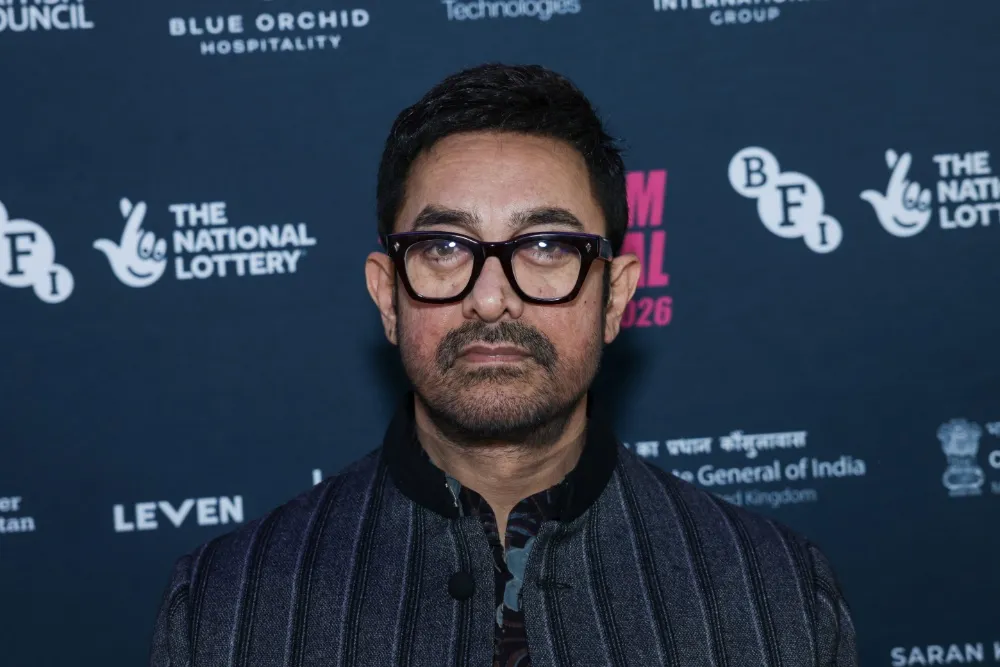
Bollywood star Aamir Khan has finally addressed one of the longest-running rumours surrounding 3 Idiots, making it clear that the beloved character Phunsukh Wangdu was never inspired by educator and climate activist Sonam Wangchuk. Speaking during a special BFI In Conversation session at London’s BFI Southbank, the actor dismissed the claim while also sharing memories from his career, the legacy of Lagaan, and the approach that has shaped his film choices over the years. The event was held as part of the London Indian Film Festival, which also celebrated the 25th anniversary of Lagaan.
The speculation has circulated for years among movie fans, with many believing that Wangchuk served as the inspiration behind the central character in Rajkumar Hirani’s blockbuster. The topic resurfaced recently after actor Omi Vaidya, who played Chatur in the film, shared a social media video suggesting a connection between the character and Wangchuk. Khan, however, used the London event to firmly put the rumour to rest.
Aamir Khan rejects the long-standing theory
Responding to the question, Khan left no room for confusion. “No, that’s not true, actually. No, no. That is a misconception,” he said. The actor further explained that neither he, director Rajkumar Hirani nor writer Abhijat Joshi knew Sonam Wangchuk when the film was being developed. According to Khan, the similarities that many viewers noticed were purely coincidental and were never part of the creative process behind the film.
Referring to Omi Vaidya’s recent remarks, Khan said, “I know that I saw a video of Chatur just recently. He said that yes. No, he’s wrong. Maybe that’s what Chatur was thinking, but I want to tell you that neither Raju [director Rajkumar Hirani] nor Abhijat [writer Joshi] were the two writers, nor I. We didn’t know about Mr. Sonam. However, what Mr. Sonam is doing is good work. In any case, he doesn’t have to be based on the character of ‘3 Idiots’ for us to respect him and the work that he does.”
While distancing the film from Wangchuk’s life, Khan also expressed concern over the activist’s health during his ongoing hunger strike. He said, “I think all of us are very concerned for his health, and we hope that it ends well. All of us are hoping that he ends his fast.” His comments made it clear that respect for Wangchuk’s work exists independently of any connection to the film.
Lagaan memories and lessons from a remarkable career
The conversation naturally shifted to Lagaan, one of the defining films of Khan’s career, which continues to enjoy global recognition more than two decades after its release. Looking back at the Oscar-nominated drama, Khan admitted that nobody involved expected the film to achieve such lasting success. Instead of thinking about awards or anniversaries, the team was simply focused on getting the film right.
“We were just frightened. It was just terrified trying to get it right,” Khan recalled while reflecting on the production. Later, he described the film as “a film about the triumph of the human spirit.” Released in 2001, Lagaan remains one of India’s most celebrated international successes and is still regarded as a milestone in Hindi cinema.
Khan also spoke about growing up in a family connected to filmmaking but revealed that becoming an actor was not encouraged at home. “My parents and everyone in my family were dead against it,” he said. Before cinema became his profession, the actor was a talented junior tennis player who even reached state champion level. Sharing a lighter memory, he joked about playing an exhibition match involving Roger Federer and Novak Djokovic, saying, “I have the distinction of having Federer and Djokovic sitting on either side of the net, trying to lower it … I’m the only person who has that privilege.”
Reflecting on his first visit to a film set during the making of Yaadon Ki Baaraat, Khan remembered feeling overwhelmed by the experience. He recalled the unpleasant smell of the pancake makeup and described the atmosphere as noisy and intimidating. Those early experiences eventually gave way to a serious interest in filmmaking, particularly after working on Ketan Mehta’s Holi, which he considers an important turning point in understanding cinema.
Why Aamir Khan never compromised on scripts
During the session, Khan offered rare insight into the decisions that shaped his career. He revealed that even while facing a series of box office disappointments, he refused to accept projects that failed to convince him creatively. One such opportunity came from filmmaker Mahesh Bhatt, but Khan chose to reject it because he did not believe in the script.
“Had I compromised that day, man, I think my entire career would be a series of compromises,” he said. “When I could stick to what I believed in at my worst, it gave me a lot of strength.” That experience, he explained, led him to follow three principles before signing any film: a strong script, complete trust in the director and a producer willing to support the creative vision with the necessary resources.
The actor also reflected on the personal struggles that followed the release of Lagaan and Dil Chahta Hai in 2001. He admitted that his divorce from Reena left him emotionally unable to work for a period, before eventually returning with Mangal Pandey. Speaking about that historical drama, Khan noted the challenge of researching the freedom fighter because very little documented material exists.
As the discussion moved toward his biggest commercial successes, including Ghajini, 3 Idiots, PK, Dhoom 3 and Dangal, Khan credited strong storytelling rather than any formula. He explained that audiences have changed dramatically in the smartphone era, where films compete with countless forms of entertainment. According to him, compelling stories remain the only constant that can truly connect with viewers.
Looking ahead, Khan confirmed that his next production will be Silkyara 41, an Indo-Australian feature inspired by the dramatic 2023 rescue mission inside Uttarakhand’s Silkyara tunnel. Directed by Kabir Khan and written by Australian screenwriter Andrew Anastasios, the film will focus on tunnelling expert Arnold Dix and the rescue operation that captured global attention. Production preparations are scheduled to begin in August, with principal photography expected to start in November.