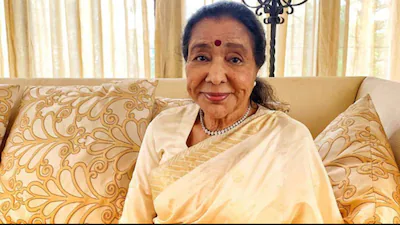
The passing of Asha Bhosle has left the nation in mourning, and now the exact cause behind her death has been officially confirmed.
The legendary singer breathed her last on April 12 at the age of 92 at Breach Candy Hospital. While the news of her demise had already shaken fans, fresh details about her health have now brought clarity to what led to the tragic loss.
What Really Happened In Her Final Hours
According to Dr Pratit Samdani from Breach Candy Hospital, Asha Bhosle passed away due to multi-organ failure — a condition where multiple vital organs stop functioning.
Just a day before her passing, reports had claimed she suffered a cardiac arrest. However, that version didn’t hold for long. Her granddaughter Zanai Bhosle stepped in to clarify that she had actually been admitted due to extreme exhaustion and a chest infection.
That small correction matters — it shows her condition worsened rapidly rather than being a sudden single event.
Final Arrangements And Public Tribute
Her son Anand Bhosle confirmed that the last rites will be held on April 13 at Shivaji Park crematorium at 4 pm, with full state honours.
Before that, fans, colleagues, and admirers will have a chance to pay their final respects between 11 am and 3 pm at Casa Grande in Lower Parel — a moment that’s expected to draw an overwhelming response from the public.
Maharashtra Cultural Minister Ashish Shelar also acknowledged the loss, calling it the end of an era not just for the state, but for Indian music as a whole.
More Than A Medical Report — The Loss Behind It
On paper, “multi-organ failure” sounds clinical. But the reality hits differently when it’s tied to a voice that defined generations.
Asha Bhosle wasn’t just a playback singer — she was part of everyday life for millions. From retro classics to experimental tracks, she constantly evolved, never sounding dated even as music itself changed around her.
Interestingly, she had once said she wished to “die singing” — a reflection of how deeply music was tied to her identity.
A Legacy That Goes Beyond The End
With a career spanning over eight decades, she recorded thousands of songs across languages and genres. She also became one of the first Indian artists to earn a Grammy nomination, long before global crossovers became common.
Even in her later years, she stayed connected with new audiences — something very few artists manage to pull off.
Today, the headlines may focus on the cause of death. But the bigger story is what she leaves behind — a catalogue of music that will continue to live on, long after the silence.