What started as a music release quickly turned into one of the biggest controversies in the Indian music scene this year. Badshah—known off-stage as Aditya Prateek Singh Sisodia—has found himself at the center of a growing backlash after his latest track Tateeree sparked outrage over its lyrics.
The controversy has now escalated beyond public criticism, with authorities stepping in and taking strict action against the song’s circulation across digital platforms.
According to updates reported by ANI, the Haryana Police have intensified their response, removing a massive number of links related to the track. So far, around 857 links have been taken down, including 154 videos from YouTube and over 700 reels from Instagram. This move comes after official notices were sent to social media platforms, instructing them to remove not just the original upload but also any re-uploads, edits, or short-form clips featuring the song.
The scale of this digital crackdown highlights how seriously the authorities are treating the matter.
Senior officials have made it clear that the issue goes beyond just a controversial song. Haryana’s Director General of Police has emphasized that any content perceived as undermining the dignity of women or minors will not be tolerated. The warning extends to everyday users as well—anyone sharing or recreating content using the track could face legal consequences.
This includes account restrictions, blocking, and even criminal charges for repeat violations.
The situation has reached the stage where an FIR has been registered at the Cyber Police Station in Panchkula, and teams are actively monitoring online activity to identify those still circulating the song. The investigation is ongoing, with authorities keeping a close watch on how the content spreads across platforms.
For Badshah, the backlash has already prompted a response.
Following mounting criticism, the rapper issued a public apology and confirmed that Tateeree has been removed from all official platforms. While the decision to take down the song was seen as an attempt to control the damage, it hasn’t stopped the controversy from growing.
In fact, the removal has only added to the discussion—raising questions about accountability, creative freedom, and the boundaries of expression in mainstream music.
The issue also caught the attention of the National Commission for Women, which has summoned Badshah and the makers of the song over allegations of obscenity and vulgarity. The Commission stated that the lyrics appear to violate multiple legal provisions, including those under the Bharatiya Nyaya Sanhita, the Information Technology Act, and the Indecent Representation of Women (Prohibition) Act, 1986.
This involvement takes the matter beyond public opinion and into formal legal scrutiny.
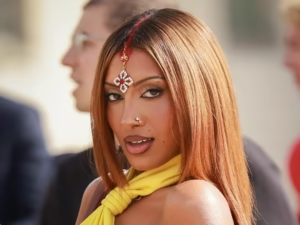
At the center of the controversy is Tateeree itself—a Haryanvi hip-hop track released earlier this month. Featuring vocals by Simran Jaglan and music by Hiten, the song attempted to blend regional influences with contemporary rap elements. Directed by Mahi Sandhu and Joban Sandhu, the music video aimed for a stylized, modern presentation.
However, it was the lyrics that triggered strong reactions.
Listeners and critics accused the track of containing objectionable references, particularly concerning women and minors. In today’s digital environment, where content spreads rapidly and reactions amplify just as quickly, the backlash gained momentum within hours of the release.
From an industry perspective, this incident reflects a larger shift in how audiences engage with music.
While hip-hop has traditionally pushed boundaries and challenged norms, there is now increasing scrutiny over the content of mainstream releases—especially when they reach wide and diverse audiences. What may have once been dismissed as edgy or provocative is now being examined through the lens of social responsibility.
For artists like Badshah, who operate at the intersection of commercial success and mass influence, this balance becomes even more critical.
The controversy also raises questions about the role of digital platforms.
With social media acting as both a distribution channel and a public forum, the lifecycle of a song no longer depends solely on its official release. Even after removal, content can continue to circulate through user-generated uploads, making enforcement a complex task.
That’s why authorities have taken a broad approach—targeting not just the original source but every instance of the song’s presence online.
At the same time, this situation has sparked debate within the music community.
Some argue that such actions could set a precedent for stricter censorship, potentially limiting artistic freedom. Others believe that accountability is necessary, especially when content crosses certain ethical or legal boundaries.
This divide reflects the ongoing tension between creative expression and social responsibility—an issue that is becoming increasingly relevant in today’s content-driven world.
For now, the focus remains on the investigation.
With legal proceedings underway and authorities continuing their crackdown, the future of Tateeree appears uncertain. Whether the controversy will have a lasting impact on Badshah’s career remains to be seen, but it has undoubtedly become a defining moment in the conversation around music, influence, and responsibility.
As the story unfolds, one thing is clear—this is no longer just about a song.
It’s about where the line is drawn, and who gets to decide when it has been crossed.