At a time when Hindi cinema is once again caught in debates around masculinity, morality, and representation, Emraan Hashmi has offered a refreshingly blunt take on why hypermasculine films continue to dominate the big screen — and why women-led stories still struggle to get backing.
Speaking candidly ahead of his next project, the actor weighed in on the ongoing cultural churn surrounding alpha-male protagonists, audience demand, and the industry’s own insecurities.
Why hypermasculine films keep winning theatrically
Emraan acknowledges the growing backlash against films that glorify aggressive masculinity, but he also points out an uncomfortable truth — these films still sell tickets. Referencing the polarising response to Animal, he explained that social media outrage doesn’t always align with ground reality.
According to the actor, the rise of “woke culture” online has amplified criticism, but theatres tell a different story. Films featuring dominant, morally grey men continue to draw crowds because a large section of the audience still identifies with that portrayal. For Emraan, the uproar and the box office success exist side by side — not in contradiction, but as part of the same ecosystem.
“People identified with it — that’s why it worked”
While many questioned Animal’s moral compass, Emraan believes its success stemmed from relatability rather than shock value alone. He noted that despite strong opposition, a significant number of men saw reflections of themselves in the film’s central character — a factor that can’t be ignored when analysing box office performance.
He doesn’t see this trend disappearing anytime soon. In fact, he suggests that cinema often mirrors social temperament, and right now, the appetite for such characters is evident.
The missing space for women-led narratives
That said, Emraan made it clear that he wants the industry to expand its storytelling range. He expressed a strong desire to see more films led by women — but admitted the reality is far more complicated.
In his view, the biggest roadblock isn’t the audience, but male insecurity within the industry itself. He argued that many male stars hesitate to take on projects where they aren’t positioned as the ultimate victor of the narrative.
“How many actors would willingly step into a film where the spotlight isn’t theirs?” he questioned, adding that stories centered on women often struggle because they don’t follow the conventional hero-wins-all formula.
Citing his own choices — without chest-thumping
Without positioning himself as an exception, Emraan pointed to his earlier career choices, including The Dirty Picture, as examples of stories he embraced because the subject matter excited him — not because it upheld traditional male dominance.
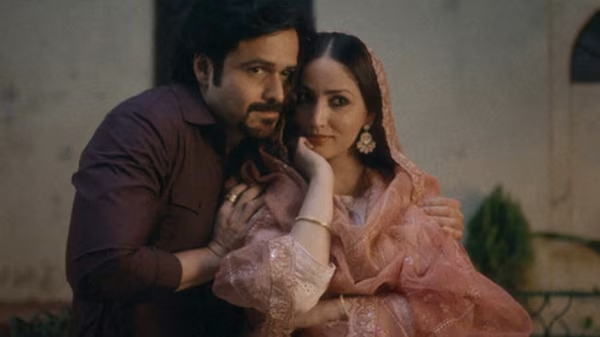
He also referenced films like Haq, suggesting that very few mainstream actors would be comfortable taking on such narratives today. According to him, shedding ego and insecurity is essential if the industry genuinely wants variety.
Cinema moves in cycles — and this is one of them
Zooming out, Emraan described the current moment as a transitional phase. He drew parallels with earlier eras — from the hypermasculine dominance of the 70s and 80s, led by icons like Amitabh Bachchan and Vinod Khanna, to the romantic wave of the 90s powered by Aamir Khan, Shah Rukh Khan, and Salman Khan.
Each phase, he believes, eventually gives way to another. The current dominance of loud, aggressive cinema may also soften — but it will take time.
Streaming shows the way forward
Interestingly, Emraan feels that OTT platforms are already ahead of the curve. With more experimental, character-driven stories finding space on streaming, he hopes theatrical cinema will eventually take cues from that freedom.
He himself will soon be seen in Taskaree, directed by Neeraj Pandey, a project that reflects his continued interest in layered storytelling beyond rigid commercial formulas.
Final words
Emraan Hashmi isn’t dismissing hypermasculine cinema — he’s contextualising it. His take acknowledges audience demand while also calling out the industry’s fear of change. As he sees it, meaningful evolution won’t come from outrage alone, but from actors and filmmakers being brave enough to step outside familiar power structures.
Until then, the box office will keep rewarding what it always has — confidence, conflict, and characters who dominate the frame.