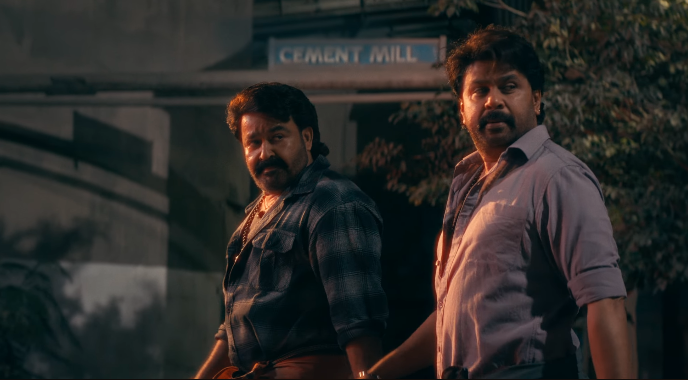
Bha Bha Ba arrives with more baggage than buzz. Marketed as an action comedy, the film also marks Dileep’s first release after his acquittal in a case that dominated headlines in Kerala for nearly eight years. That context hangs heavy over the film — and much like public reaction to the verdict, the movie itself lands in mixed, often uneasy territory.
What the film is trying to be
The title Bha Bha Ba stands for Bhayam, Bhakthi, Bahumanam (fear, devotion, respect). Directed by debutant Dhananjay Shankar and written by Fahim Safar and Noorin Shereef, the film is sold as a comedy but is essentially a revenge drama dressed in satire and meta humour.
At its centre is Dileep, playing a loud, eccentric man trapped in misunderstandings, exaggeration, and social commentary — a role designed to tap straight into the comic persona that made him a household name in the late ’90s and 2000s.
Dileep’s performance: familiar but hollow
In the first half, Dileep leans heavily on old-school humour — expressive reactions, fast dialogue delivery, and situational comedy meant to trigger nostalgia. For a while, it works. There’s comfort in seeing him operate in familiar territory.
But the familiarity soon becomes repetition. As the film moves forward, the character doesn’t evolve, the humour loops back on itself, and the emotional stakes never deepen. The second half attempts to introduce a social message, but it feels rushed and disconnected, robbing the performance of any lasting impact.
This is not a reinvention, nor a risky comeback choice. It feels like a comfort pick, and in today’s Malayalam cinema landscape, that safety net works against the film.
Writing and direction: a weak foundation
On paper, the idea of a mentally unstable man justifying a kidnapping as part of a revenge arc sounds intriguing. On screen, however, the execution struggles. The screenplay is bloated, repetitive, and tonally inconsistent, constantly rehashing the same situations in different forms.
The shift from comedy to message-heavy drama is abrupt, making the two halves feel like different films stitched together. Meta references — especially to older Malayalam and Tamil cinema — are overused and may fly over the heads of younger viewers, further limiting the film’s appeal.
Supporting cast: mostly wasted potential
Actors like Vineeth Sreenivasan, Dhyan Sreenivasan, Ashokan, Redin Kingsley, and Sidharth Bharatan are present largely as comic devices rather than characters. Their roles exist to create confusion or amplify Dileep’s antics, leaving little room for depth.
That said, Vineeth and Dhyan manage to raise a few genuine laughs, largely because of their self-aware, self-mocking performances. Female characters, unfortunately, are almost entirely forgettable, serving no purpose beyond surface-level moments.
Mohanlal’s cameo steals the show
The film’s biggest crowd-pleaser is Mohanlal’s extended cameo as Ghilli Bala, a die-hard Thalapathy Vijay fan. His timing, one-liners, and sheer screen presence instantly lift the film whenever he appears.
This also marks Dileep and Mohanlal’s reunion after 14 years, their last collaborations being Christian Brothers and China Town (2011). It’s hard not to view Mohanlal’s appearance as a strategic move to add goodwill and star power at a sensitive moment in Dileep’s career.
Subtext and image rehabilitation
Beyond its surface story, Bha Bha Ba often feels like it’s trying to address real-life narratives indirectly. The kidnapping angle, repeated references to media trials, faces plastered across towns, and emphasis on “law taking its course” all suggest a meta attempt at reframing public perception.
While the intention may be clear, the approach feels too transparent, making the messaging more distracting than effective.
Final verdict
Dileep once ruled Kerala cinema with relatable, clean, middle-class comedies built on sharp timing and underdog charm. Bha Bha Ba tries to revive that magic but ends up reminding viewers how far the gap has grown.
Despite a few smiles, a strong Mohanlal cameo, and flashes of nostalgia, the film fails to justify its own weight — narratively or emotionally. As a comeback vehicle, it plays things too safe. As a film, it struggles to stand on its own.
Verdict: A forgettable, uneven watch that leans heavily on the past — and proves that nostalgia alone isn’t enough anymore.