Rian Johnson doesn’t just stretch the Knives Out template with Wake Up Dead Man — he quietly breaks it apart and rebuilds it into something far more unsettling. Streaming on Netflix from December 12, the third Benoit Blanc mystery abandons playful excess and glossy satire in favor of shadow, silence, and moral unease. This is a whodunit that doesn’t wink at you. It stares back.
A Mystery That Changes the Rules
From its first moments, Wake Up Dead Man signals that familiar comforts are off the table. There are no sunlit estates or cartoonishly rich suspects this time. Instead, Johnson drops us into a misty town where an aging stone church looms over everything — a place where belief binds people together and secrets are protected with almost religious devotion.
The pacing is deliberate, sometimes uncomfortably so. Scenes linger. Conversations trail off. The tension doesn’t explode — it slowly tightens. Johnson trusts atmosphere more than plot gymnastics, letting discomfort do the heavy lifting.
Faith as the Central Suspect
The mystery ignites with the death of Monsignor Jefferson Wicks (Josh Brolin), the town’s powerful church leader, found dead just days before Good Friday. When Benoit Blanc arrives, it becomes clear that this isn’t just a murder investigation — it’s an autopsy of authority.
The suspect list is layered, not flashy:
- A conflicted young priest, Father Jud (Josh O’Connor), torn between belief and buried wounds
- A longtime church aide (Glenn Close) whose quiet loyalty masks dangerous knowledge
- A sharp-edged lawyer played by Kerry Washington
- A morally flexible doctor (Jeremy Renner)
- An enigmatic author portrayed by Andrew Scott
- A withdrawn musician (Cailee Spaeny) carrying grief she can’t articulate
No one here feels overtly villainous — and that’s the point. Guilt spreads softly, infecting every conversation.
Mood Over Mechanics
What sets this film apart from Knives Out and Glass Onion is its refusal to chase spectacle. Candlelit interiors, echoing corridors, and graveyards under fog aren’t just visual choices — they reflect the film’s obsession with suppressed truth.
Johnson interrogates faith not as salvation, but as pressure. Belief becomes armor. Morality becomes camouflage. The humor is minimal, almost hesitant, replaced by an uneasy stillness that rewards patience rather than demanding attention.
Benoit Blanc, Reimagined
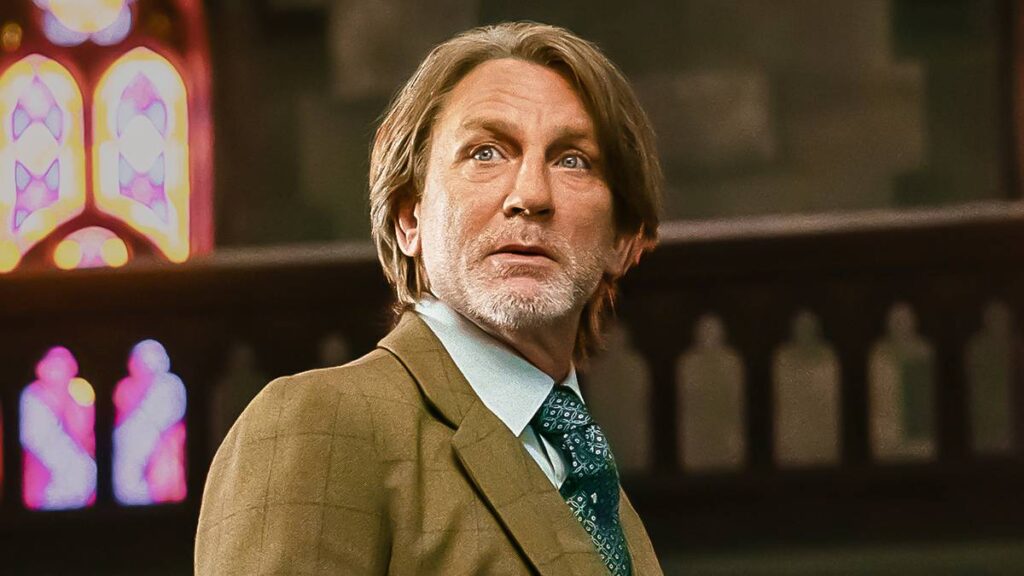
Daniel Craig gives his most restrained performance as Benoit Blanc to date. The Southern lilt remains, but the bravado is dialed way down. This Blanc listens more than he speaks. Observes more than he explains. There’s a quiet weariness to him — as if he’s less interested in winning the game and more burdened by what the truth costs people.
Josh O’Connor emerges as the emotional spine of the film, delivering a raw, unpredictable performance that grounds the story’s spiritual conflict. The ensemble works in harmony, never competing for spotlight, reinforcing the film’s collective sense of unease.
What Worked
- A daring tonal shift that deepens the franchise
- Strong atmospheric direction and production design
- Daniel Craig’s most emotionally layered take on Blanc
- A haunting score and confident restraint
What Didn’t
- The slow burn may test viewers expecting sharper twists
- Minimal humor compared to earlier entries
- Requires patience and attention — not casual viewing
Final Verdict
Wake Up Dead Man is the boldest and most introspective Knives Out film yet. It trades punchlines for pressure, spectacle for soul-searching, and clever tricks for lingering discomfort. It may not be the most immediately entertaining chapter in the series — but it’s easily the most mature.
This is a mystery that doesn’t fade when the credits roll. It settles in quietly. And it stays.