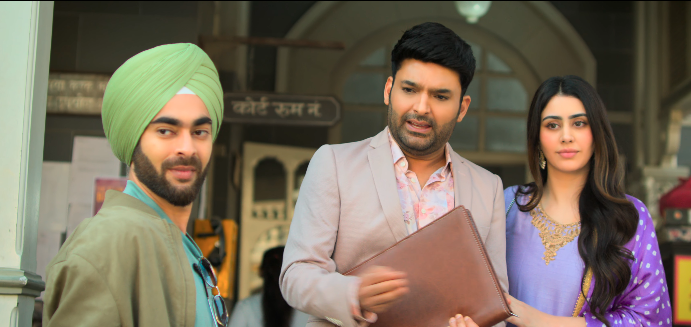
Kapil Sharma’s return to the big screen sticks firmly to the philosophy of familiarity over experimentation, delivering a follow-up that plays safe, familiar, and mostly predictable — for better and for worse.
Directed by Anukalp Goswami, the sequel carries forward the chaos-driven comedy template of the original, with a few new twists layered on top, but without straying too far from what worked the first time around.
Story & Setup
The film once again places Kapil Sharma at the centre of an ever-expanding marital mess. This time, he plays Mohan Sharma, a man from Bhopal who just wants to marry the woman he loves — Sanya (Warina Hussain). Family objections rooted in religious differences push him into a series of impulsive decisions that spiral wildly out of control.
What begins as a plan to convert religion soon turns into a string of accidental marriages — first to Ruhi (Ayesha Khan), then Meera (Tridha Choudhary), and eventually Jenny (Parul Gulati), all while Mohan desperately tries to keep his lies intact. The situation escalates further when the police start tracking him after a confession made in a moment of guilt.
Unlike the first film, the sequel leans more heavily into religion-based confusion as a narrative device, which becomes both its biggest talking point and its most delicate balancing act.
What Works
The film opens on a light, breezy note, and for a while, it genuinely works. The humour is mostly clean, avoiding cheap shock tactics, body-shaming jokes, or crass double meanings — something that works in its favour, especially for family audiences.
Kapil Sharma’s comic timing remains the film’s biggest strength. His comfort with situational humour keeps many scenes afloat even when the writing feels thin. Manjot Singh, returning as Mohan’s best friend Hubby, shares an easy chemistry with Kapil, and their banter provides some of the film’s better laughs.
A special mention goes to Asrani, whose appearance brings a warm sense of nostalgia. Shot when he was already in his early 80s, the veteran actor still manages to leave an impression, reminding audiences why he was such a beloved comic presence.
The supporting cast — Akhilendra Mishra and Vipin Sharma as Mohan’s father and father-in-law — deliver dependable performances that ground the madness.
Where It Falters
The biggest issue with KKKPK 2 is its stretched narrative. While the first half maintains a decent pace, the humour begins to thin out after the interval. The film struggles to decide when to wrap things up, dragging on even after what feels like a natural climax.
There’s also a noticeable lack of escalation in jokes. Situations repeat themselves with minor variations, which leads to diminishing returns as the runtime progresses.
The music is another weak link. Several songs interrupt the flow without adding much to the story, feeling more like mandatory inclusions than organic storytelling tools.
Cast Performances
- Kapil Sharma: Effortlessly charming, carrying the film largely on timing and screen presence
- Manjot Singh: A reliable comic partner who complements Kapil well
- Warina Hussain, Tridha Choudhary, Ayesha Khan, Parul Gulati: Fit comfortably into their roles, though none are given enough material to truly stand out
- Asrani: Brief but memorable, adding emotional and nostalgic value
Final Verdict
Kis Kis Ko Pyaar Karoon 2 knows exactly what it wants to be — and refuses to be anything else. It doesn’t aim for reinvention or bold storytelling, choosing instead to stay within its comfort zone. While that approach brings a few genuinely funny moments and solid performances, the stretched runtime and repetitive humour stop it from fully clicking.
It’s not a laugh riot, but it’s not a misfire either. For viewers looking for light, clean, family-friendly comedy, this sequel remains an easy, if slightly overlong, watch.