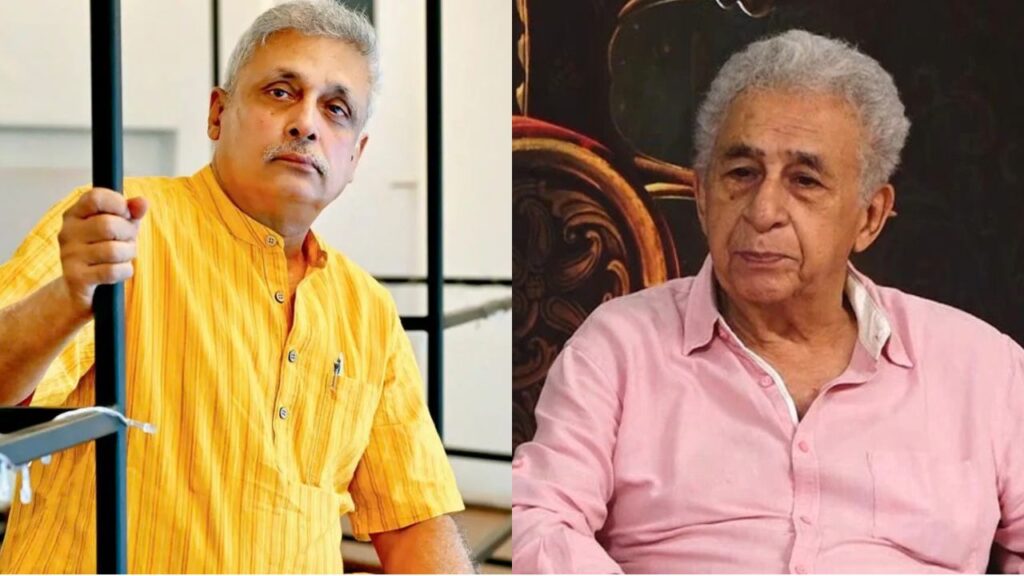
Piyush Mishra has reopened his public disagreement with Naseeruddin Shah, questioning why the veteran actor has spoken up for some political and student-led causes while, in Mishra’s view, remaining silent on others. His latest remarks came after Shah met Cockroach Janta Party founder Abhijeet Dipke and joined a protest in Mumbai demanding the resignation of Chief Election Commissioner Gyanesh Kumar.
In a video circulating on social media, Mishra directly addressed Shah and pointed to Captain Smit Machchhar, the Indian flydubai pilot who was recently praised for his actions during a serious mid-air incident.
Referring to Machchhar, Mishra told Shah: “Please comment on this as well, congratulate the captain, he will feel nice.”
But the pilot was only one part of Mishra’s argument. The actor-writer also raised the recent unrest at Lovely Professional University and returned to an older disagreement involving student protests in Jharkhand, turning his latest video into a broader challenge to what he sees as inconsistency in celebrity activism.
Shah’s meeting with Abhijeet Dipke triggered the response
The immediate trigger was Shah’s appearance around the CJP demonstration at Mumbai’s Shivaji Park on October 2.
The protest was organised amid controversy surrounding the Special Intensive Revision of electoral rolls. Protesters demanded the resignation of Chief Election Commissioner Gyanesh Kumar, while several film personalities — including Shah, Shabana Azmi and Vishal Dadlani — were among those who attended or expressed support.
Ahead of the demonstration, Shah met Dipke in an interaction that quickly spread online. When Dipke told the veteran actor that he was a huge fan, Shah responded that he was a fan of Dipke too, embraced him and praised his work.
Mishra began his video by acknowledging that meeting before shifting to the subjects on which he wanted Shah to speak.
That makes the dispute less about Shah simply meeting Dipke and more about a larger question Mishra has been raising: which causes public figures choose to amplify, and whether they should be expected to respond consistently across politically different situations.
Why Smit Machchhar became central to Mishra’s argument
Mishra singled out Captain Smit Machchhar because the pilot had become a widely praised figure following the flydubai incident.
Reuters reported that Machchhar was seriously injured after being attacked by a co-pilot during a flight to Israel. Despite his injuries, he managed to unlock the cockpit, allowing others aboard to intervene; two off-duty pilots later helped land the aircraft safely in Saudi Arabia.
Mishra cited the incident as something deserving public recognition from Shah. In his video, he credited Machchhar with saving around 180 lives, although reports have differed on the exact number of passengers and people aboard. The larger point of his remarks was that, in his view, Machchhar’s actions deserved the same sort of public acknowledgement that Shah has given political movements and activists.
That distinction is important. Mishra was not responding to anything Shah had said about Machchhar; he was criticizing Shah for not publicly commenting on the incident, at least as far as Mishra was aware.
Mishra also brings up LPU and an older Jharkhand dispute
The video then moved to Lovely Professional University, where recent unrest led to clashes involving students and police following rumours surrounding an alleged incident on campus. The university’s chancellor subsequently disputed some of the claims circulating online and described the unrest as being driven by misinformation, while investigations continued.
Mishra asked Shah to extend his concern to LPU students as well, while making allegations about the treatment of students during the confrontation. Those comments represent Mishra’s characterization of events, rather than an independently established account of everything that happened on campus.
He also revived their earlier disagreement over protests by students in Jharkhand. Mishra claimed that when he approached Shah seeking help for those students, Shah sent him a poem by a Pakistani poet. Mishra argued that the protesters needed practical assistance such as food rather than poetry.
The exchange has history. Shah had earlier criticized silence among celebrities during a CJP-linked protest, using the metaphor that a dog with a bone in its mouth cannot bark. Mishra later challenged that remark while participating in the Jharkhand protests, effectively asking why the same standard was not being applied to other causes.
This is becoming an argument over celebrity activism itself
The latest episode is therefore more than a personal quarrel between two respected actors.
Shah has increasingly used his public platform to support political and civil-society causes. Mishra’s response is not that actors should stay away from politics; instead, he is questioning what he regards as selective political engagement.
That does not establish that Shah is obligated to comment on every major news event, nor does silence automatically indicate opposition or indifference. Public figures routinely choose which causes they speak about, and there is no evidence that Shah has publicly explained why he has or has not addressed the incidents Mishra listed.
Mishra nevertheless made clear that he intends to keep challenging those choices. He ended his message by saying: “Now, whenever you make a statement, you’ll get a response from Piyush Mishra.”
As of October 5, Shah had not publicly responded to Mishra’s latest video.
That leaves their disagreement in an unusual place: what started around individual protests has evolved into a much broader debate over whether celebrities who enter political conversations should be judged not only for what they say, but also for the issues on which they choose to remain silent.