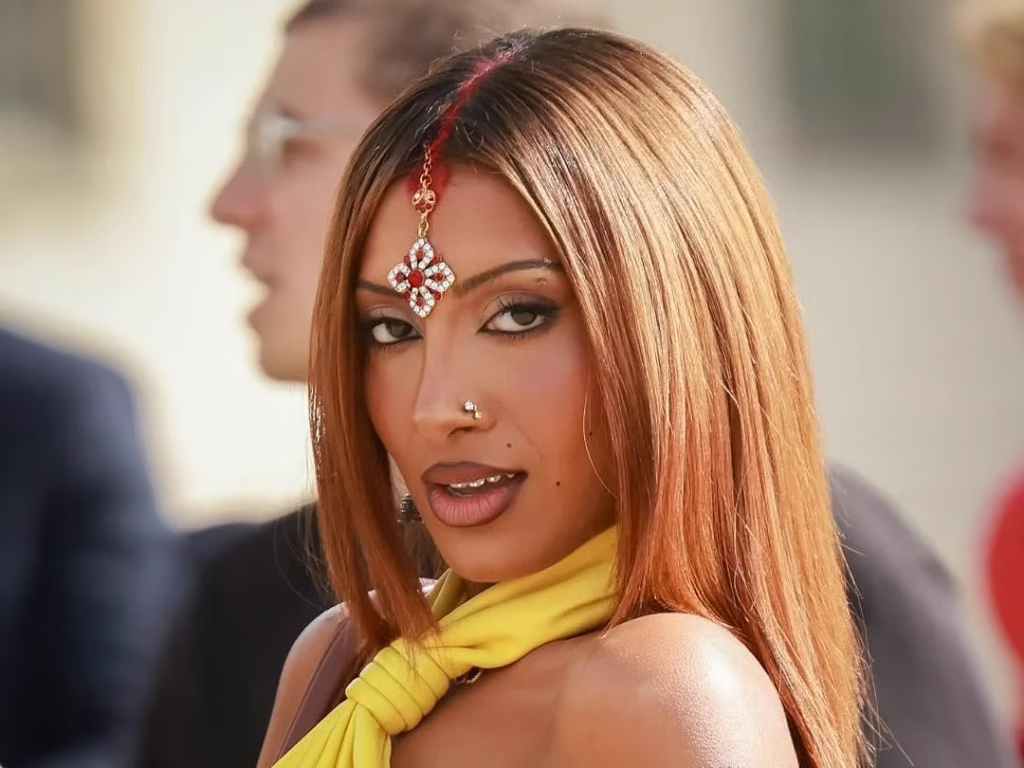
KATSEYE’s Lara Raj has responded to the debate surrounding one of her Paris Fashion Week looks, making an important distinction about the red mark that sparked much of the discussion. While many social media users described it as sindoor, Lara has identified it as kumkum and explained that, for her, it carries a personal connection to family, worship and her Indian heritage. IndulgExpress
The conversation began after Lara attended Loewe’s Spring/Summer 2027 show in Paris on October 2 alongside fellow KATSEYE member Megan Skiendiel. She wore a bright yellow Loewe dress with Indian jewellery, including a bindi and maang tikka, while a red streak along her centre hair parting quickly became the most-discussed element of the look. Some critics interpreted it as sindoor and questioned why an unmarried woman was wearing something commonly associated with marriage in many Hindu traditions. IndulgExpress
Lara, however, has now explained the styling in her own terms.
Lara says kumkum has been part of her life since childhood
In an Instagram post addressing the look, Lara said wearing the dress with Indian jewellery and kumkum made her feel confident and beautiful.
She explained: “kumkum has been part of my life since childhood, a sacred blessing i’ve grown up receiving from my family during puja and aarti.” AOL.com
Lara also described it as representing intuition, strength and the divine feminine energy she feels connected to. She said the Paris look was styled in her own way while paying tribute to two women whose approach to Indian beauty has influenced her: legendary actor Rekha and her mother. AOL.com
That Rekha reference is particularly relevant to understanding the styling. Lara had already said during the Loewe event that Rekha inspired the red kumkum and tikka in the look. The singer therefore appears to view the styling not as a statement about her marital status, but as a combination of personal tradition, fashion influence and cultural expression. Jang
The distinction does not completely settle the online argument because kumkum and sindoor can carry different meanings depending on community, ritual and how they are applied. The placement along Lara’s hair parting is one reason many viewers immediately interpreted it as sindoor, which is widely associated with married Hindu women. Lara’s explanation, however, establishes what she herself intended the substance and styling to represent. AOL.com
Lara’s mother enters the conversation
Lara’s mother, Kavita Raj, has also weighed in as the debate expanded beyond the outfit itself.
Screenshots of her response circulated online after criticism of Lara’s styling. The response discussed interpretations of the hair parting and the spiritual symbolism surrounding the divine feminine, while also questioning whether cultural and sacred traditions must remain fixed in one interpretation across generations. Her broader argument was that Lara should have the freedom to explore her heritage in a way that feels authentic to her rather than being restricted by externally imposed ideas of what is “proper.” Reddit
That does not mean everyone agreed. Discussion around the mother’s response remained divided too, with some commenters supporting the idea of an unmarried woman reclaiming or reinterpreting a symbol, while others argued that the historical and marital associations of sindoor should not be separated from its use. Reddit
The important distinction is that this is no longer simply a story about an accessory spotted at Fashion Week. Lara has now explicitly supplied her own meaning for the look, while her mother has defended her ability to decide how she engages with her cultural inheritance.
This is not Lara’s first time bringing Indian identity into her style
There is also useful context missing from some of the criticism: Lara’s use of Indian cultural elements did not begin in Paris.
In a 2025 interview with Teen Vogue, she spoke at length about making the bindi and Om jewellery visible parts of her style. Lara said she had been mocked for those elements growing up and wanted other brown girls to see them differently. She also specifically credited her mother’s habit of pairing traditional wedding jewellery with American clothing as an early fashion influence. Teen Vogue
That history does not automatically resolve disagreements about the Paris Fashion Week look. People within the same culture can reasonably attach very different meanings to the same tradition, particularly when religion, gender and marriage are involved.
But it does change one part of the conversation. Lara’s decision to incorporate Indian elements into her image is not something created for a single Fashion Week appearance. It has been a visible part of how she has presented herself throughout KATSEYE’s rise.
This time, the placement of the kumkum pushed that expression into a much more complicated cultural debate. Lara’s response makes her position clear: she sees the mark as something she grew up receiving as a blessing, something connected to feminine strength, and something she chose to reinterpret through a look inspired by both Rekha and her mother. AOL.com