KATSEYE member Lara Raj has unexpectedly found herself at the center of a cultural debate after bringing a distinctly Indian beauty reference to Paris Fashion Week.
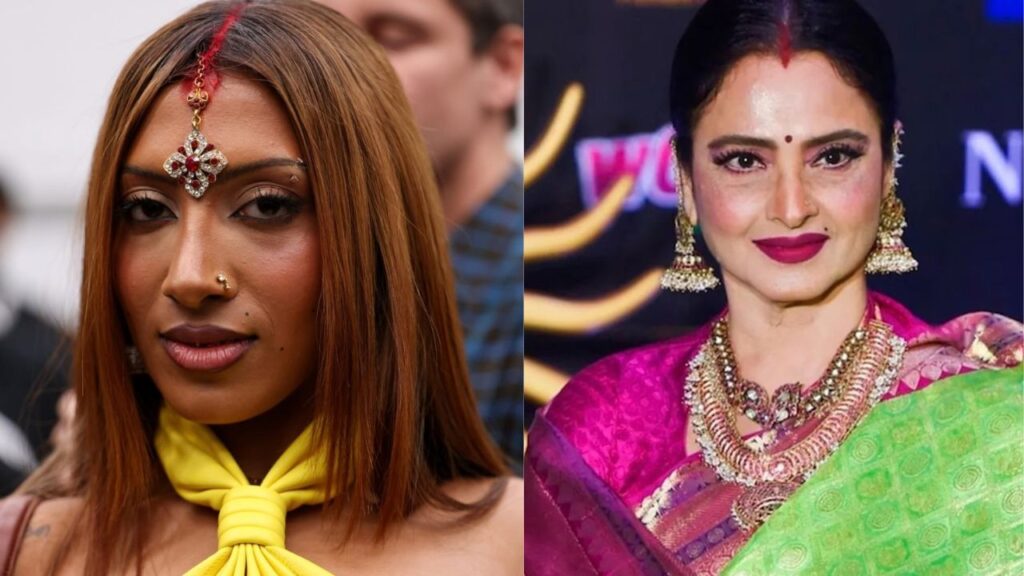
Lara attended the Loewe Spring/Summer 2027 show on October 2 alongside fellow KATSEYE member Megan, wearing a bright yellow halter dress paired with a bindi, maang tikka, traditional-style jewellery and a prominent streak of red along the center parting of her hair. That final detail was widely identified online as sindoor, traditionally associated in many Hindu communities with married women.
The images quickly generated criticism from users who felt a symbol carrying marital and religious significance was being reduced to a fashion accessory.
But Lara later provided context that changes the conversation considerably.
Speaking during the Loewe event, she described the red mark as kumkum and said the look was inspired by Bollywood legend Rekha, whose signature public styling has long included prominent vermilion alongside elaborate Indian jewellery.
That means the styling was apparently not intended as a statement about Lara’s marital status.
Lara says Rekha inspired the look
The Rekha connection is probably the most important detail missing from many of the early reactions.
Lara specifically referenced the veteran actor while explaining the beauty choice, according to reports covering her comments from the Loewe show.
Rekha has made bold sindoor one of her most recognizable red-carpet signatures over decades, often wearing it alongside kanjeevaram saris, heavy gold jewellery and dramatic makeup.
Lara’s Paris look translated some of those visual references into a much more contemporary setting.
Instead of a traditional sari, she paired the Indian accessories with a short canary-yellow Loewe dress. Her styling included a gemstone bindi, maang tikka, nose jewellery and anklets, while the red kumkum running through her hair parting became the element that attracted the most attention.
Seen through that lens, Lara appears to have been referencing a specific Indian style icon rather than randomly selecting a cultural symbol for shock value.
That explanation, however, has not ended the argument.
Why are some people criticizing Lara’s sindoor?
Much of the criticism centers on the meaning traditionally associated with sindoor.
In many Hindu traditions, married women apply vermilion along the parting of their hair as a symbol of marriage. Because Lara is not publicly known to be married, some social-media users questioned why she would wear it at all. Others argued that treating it primarily as a fashion element removes the context that gives the symbol meaning.
One of the recurring reactions online has essentially been: Is sindoor now becoming an aesthetic?
That concern has also overlapped with a wider conversation about global fashion’s use of South Asian imagery.
Lara had already drawn debate during the same Paris Fashion Week trip after wearing an archival Roberto Cavalli piece featuring an image of the Hindu goddess Lakshmi. Some users viewed both looks together and accused her styling of turning religious imagery into fashion decoration.
Others strongly disagreed.
They argued that Lara has repeatedly incorporated Indian jewellery, bindis and other references into her personal style, and that someone expressing elements of her own cultural background should not automatically be described as engaging in cultural appropriation.
The debate gets more complicated because Lara chose Rekha as her reference
Rekha makes the conversation much less straightforward.
Her own use of sindoor has frequently attracted curiosity precisely because she has worn it publicly outside the conventional framework people associate with a married woman displaying the symbol.
That history appears to be what Lara was referencing.
As a result, some supporters have interpreted her look as a form of reclamation: removing the idea that a woman’s right to wear vermilion must necessarily depend on marital status.
Critics argue almost the opposite.
Some say traditions such as sindoor have historically placed expectations primarily on women, and turning the same symbol into fashion does not automatically make that history empowering. That disagreement has produced an unusual situation where both people defending Lara and people criticizing her are sometimes framing their arguments through feminism.
There is no single agreed interpretation because sindoor itself does not have an identical meaning or usage across every Indian community.
That makes blanket claims such as “only married women can ever wear red powder this way” overly simplistic, just as dismissing the criticism by saying it is “only fashion” ignores why many people attach deeper significance to it.
This is less a cultural-appropriation story than a debate about cultural ownership
Perhaps the strangest part of the backlash has been accusations that Lara is “appropriating” Indian culture.
That description has been challenged even by people who dislike the styling itself.
The more interesting debate is about what happens when someone with a genuine connection to a culture interprets its traditions in ways that other members of that culture dislike.
Those two things can coexist.
Lara can be intentionally referencing Indian visual culture while some Indian viewers can still feel that the particular execution misunderstands or trivializes a symbol important to them.
Likewise, disagreement with the look does not prove Lara intended disrespect.
Her stated inspiration points in the opposite direction: she was consciously referencing Rekha.
That distinction is worth preserving because online controversies often flatten intention, symbolism and audience response into the same thing.
Lara has not issued an apology — because she has already explained the inspiration
As of October 3, there has been no separate apology from Lara over the Paris Fashion Week look.
There also has not been any indication that she is retracting it.
Instead, the relevant public explanation remains her comment that the red kumkum was inspired by Rekha.
That leaves the controversy in a more interesting place than a typical celebrity fashion backlash.
It is not really about whether Lara secretly got married.
It is about whether an old cultural symbol should remain attached to its traditional meaning, whether younger women can reinterpret it, and how those choices change when they are displayed on one of fashion’s largest international stages.
Lara may have gone to Paris intending to pay tribute to Rekha.
She ended up starting a much larger conversation about who gets to decide what tradition looks like when it becomes fashion.