Some films entertain for a few hours before quietly fading from memory. Others stay with you because of a memorable performance or a spectacular action scene. Christopher Nolan’s The Odyssey belongs to a far rarer category, one that leaves you thinking about its ideas long after the credits disappear. Rather than treating Homer’s timeless poem as another large-scale blockbuster, Nolan transforms it into an emotional journey where every image, every silence, and every decision carries weight.
The film never feels interested in chasing empty spectacle despite its enormous scale. Every frame appears carefully designed to serve the story instead of simply showing off technical ambition. The result is a film that asks viewers to invest emotionally as much as visually, rewarding patience with moments that feel surprisingly intimate for a production of this size.
A Timeless Story Finds New Life
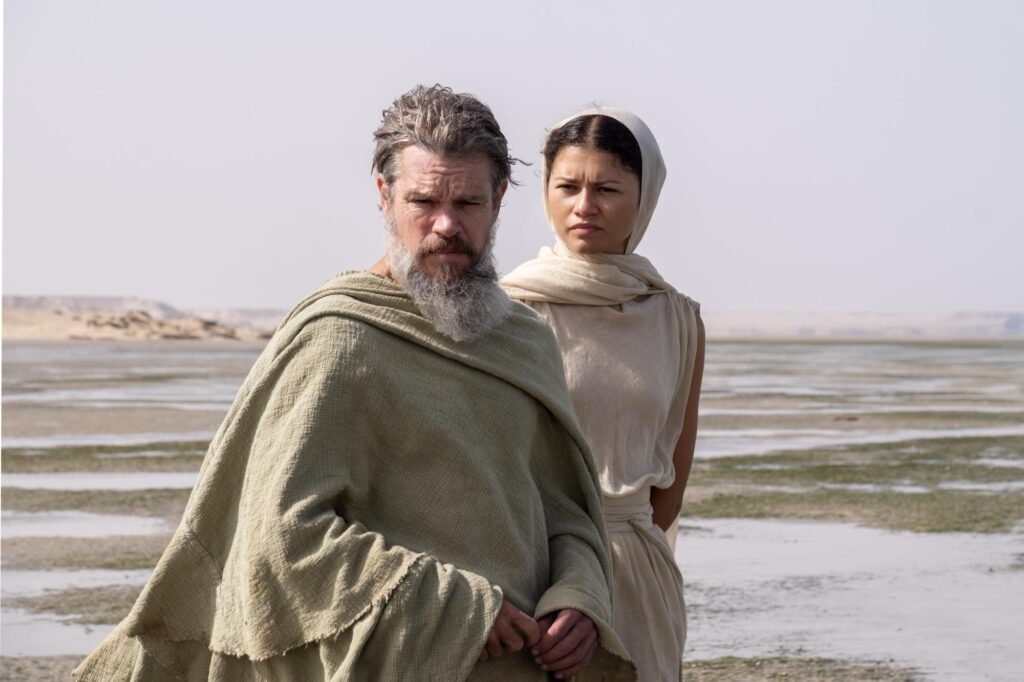
Matt Damon leads the film as Odysseus, the legendary warrior whose long journey home stretches across nearly two decades after the Trojan War. While he battles impossible odds to return to Ithaca, Anne Hathaway’s Penelope wages a different kind of war within the palace. Surrounded by ambitious suitors eager to claim the throne, she cleverly delays her decision by weaving a burial shroud each day before secretly undoing her work every night, buying precious time as hope slowly begins to fade.
Tom Holland delivers an equally meaningful performance as Telemachus, a young man raised more by stories than memories of his father. His search for identity becomes one of the film’s strongest emotional threads, making the reunion he longs for feel just as important as Odysseus’ physical voyage. Nolan balances these parallel stories with remarkable confidence, ensuring that both journeys carry equal emotional importance.
Instead of presenting mythology as distant history, the film makes its themes feel surprisingly personal. Ideas of family, sacrifice, loyalty and forgiveness drive every major decision, allowing ancient characters to feel relatable to a modern audience. At its heart, The Odyssey argues that even the greatest legends are ultimately stories about finding your way back to the people who matter most.
Performances Match the Film’s Ambition
The ensemble cast could easily have become a distraction, yet Nolan avoids that trap by allowing each actor to disappear into their character. Matt Damon anchors the film with quiet determination rather than exaggerated heroism, giving Odysseus a deeply human vulnerability beneath his legendary reputation. Anne Hathaway brings remarkable emotional depth to Penelope, portraying both unwavering strength and the exhaustion of someone who has spent years refusing to surrender hope.
Tom Holland continues to prove his dramatic range through Telemachus, whose emotional conflict becomes increasingly compelling as the story unfolds. Lupita Nyong’o, Robert Pattinson, Zendaya, Mia Goth and Elliot Page all contribute memorable performances that enrich the world without ever pulling attention away from the central family story. Their presence adds texture to the mythology instead of relying on star power alone.
Much of the discussion surrounding the film’s casting fades away once the narrative settles into place. Rather than watching recognizable celebrities, audiences are encouraged to see legendary figures whose struggles have echoed through generations. That transformation is one of the film’s quietest achievements.
Nolan Blends Spectacle With Emotion
Visually, The Odyssey ranks among Christopher Nolan’s most ambitious productions. The large-format cinematography captures breathtaking landscapes while maintaining an intimacy that keeps viewers connected to the characters instead of overwhelming them with scale. Massive set pieces feel impressive, but they never overshadow the emotions driving each scene.
Ludwig Göransson’s score becomes an essential storytelling tool throughout the film. Powerful orchestral passages elevate moments of triumph, while restrained compositions allow grief, loneliness and longing to breathe naturally. The music never simply accompanies the images; it strengthens the emotional impact of nearly every major sequence.
The film also ventures into unexpectedly unsettling territory during encounters with mythical creatures, including the Cyclops and Circe. Nolan stages these sequences with measured suspense rather than relying solely on visual effects, creating moments that feel genuinely tense while remaining faithful to the mythological atmosphere. They provide some of the film’s most unforgettable scenes without disrupting its emotional rhythm.
Perhaps the greatest achievement of The Odyssey is its unwavering focus despite its enormous scope. Beneath the mythology, battles and breathtaking visuals lies an intimate story about a husband trying to reunite with his wife and a father hoping to reach the son he barely knows. That emotional foundation gives every triumph and every setback genuine significance.
Few modern epics manage to balance technical brilliance with heartfelt storytelling so effectively. Whether audiences connect with its themes or simply admire its craftsmanship, The Odyssey refuses to settle for being another blockbuster spectacle. It aims higher, inviting viewers into a story about endurance, family and the enduring power of home, and it leaves a lasting impression long after the journey ends.