Border 2 doesn’t arrive quietly. It marches in with folded flags, swelling background music, and the kind of nostalgia that modern CGI-heavy cinema simply cannot manufacture. In a time where war films often rely on digital spectacle and scale, Border 2 banks on something far more powerful — memory. The kind that turns a packed theatre into a shared time capsule, where familiar tunes and thunderous dialogue still make grown adults sit up a little straighter.
Yes, the film knows exactly why you’ve come. And yes, it gives you Sunny Deol in full, unapologetic form. But surprisingly, Border 2 doesn’t stop there.
The Story: Old War, New Perspectives
Set against the backdrop of the 1971 Indo-Pak war, Border 2 doesn’t attempt to reinvent history. Instead, it reframes it. The narrative unfolds through three different branches of the Indian armed forces — the Army, Navy, and Air Force — offering parallel journeys that eventually intersect on the battlefield.
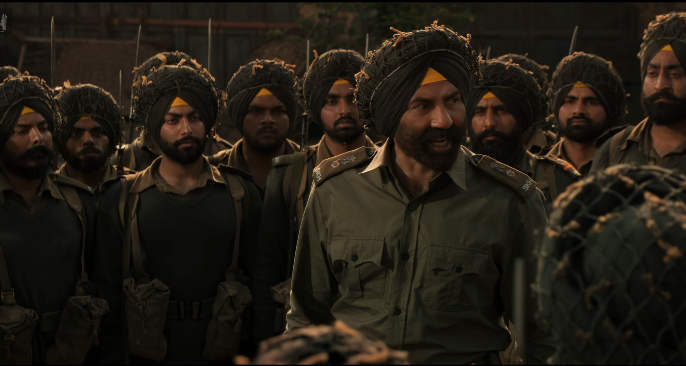
At the centre is Lt Col Fateh Singh Kaler (Sunny Deol), a commanding presence whose experience anchors the film. Alongside him are Major Hoshiar Singh Dahiya (Varun Dhawan), Lt Commander MS Rawat (Ahan Shetty), and Flying Officer Nirmal Jit Singh (Diljit Dosanjh). Each represents a different service, a different temperament, and a different emotional rhythm, but all are driven by the same unwavering sense of duty.
The screenplay smartly divides the film into two halves. The first focuses on training, camaraderie, family ties, and quiet moments before the storm. The second plunges headfirst into full-scale warfare.
First Half: Where the Film Truly Works
Up to the interval, Border 2 is gripping and confident. The writing allows the characters to breathe, giving each actor enough space to establish personality and emotional stakes. The banter between Varun, Diljit, and Ahan feels organic, never forced, and helps build investment before the guns start firing.
Visually, the film is striking. The landscapes are captured with restraint and beauty, while early military sequences maintain tension without overstating drama. There’s a sincerity here — the kind that doesn’t rush emotion, but lets it settle.
This is also where the nostalgia hits hardest. The music, the uniforms, the rhythm of old-school patriotic cinema — it all works because the film doesn’t try to be ironic or self-aware. It believes in what it’s showing.
Second Half: Scale Over Substance (Mostly)
Post-interval, the film grows louder, bigger, and more ambitious — sometimes to its own detriment. The idea of showing the war from all three services is genuinely exciting, but the execution doesn’t always live up to the intent.
The action sequences are expansive, but they start to feel familiar. Tanks roll, explosions erupt, and strategies unfold, but the grammar of war cinema feels recycled in places. There’s simply too much going on, and not every moment lands with the impact it’s aiming for.
That said, the climax does a lot of heavy lifting. It pulls the film back together, delivering emotional payoff and reminding you why patience through the slower stretches is worth it.
Performances: Sunny Deol Does What Sunny Deol Does Best
Let’s be honest — a large part of the audience is here for Sunny Deol. And he does not disappoint. Whether he’s playing a stern officer, a protective family man, or a battle-hardened leader, his screen presence remains undeniable. He doesn’t shout through the film; he commands it.
Varun Dhawan delivers one of his more committed performances. Those expecting meme-worthy moments may be surprised — he approaches the role with sincerity and effort. While the Haryanvi accent is inconsistent, his emotional scenes, especially with Medha Rana as his wife, add genuine weight.
Diljit Dosanjh looks completely at ease, bringing warmth and charm without undercutting the seriousness. His pairing with Sonam Bajwa works effortlessly, giving his track emotional balance.
Ahan Shetty, unfortunately, gets the weakest arc. He tries hard, and while he does register his presence, his storyline never reaches the same emotional intensity as the others.
Strong support comes from Mona Singh, whose performance adds quiet strength, and the women across the film who ground the soldiers’ stories in something personal and real.
Music and Technical Aspects
The background score elevates several moments, especially when the writing thins out. The soundtrack blends old-school patriotism with contemporary emotion, never overpowering the narrative. The music isn’t just ornamental — it’s part of the film’s emotional machinery.
Technically, the film is polished, even if the visual effects occasionally feel overused rather than impactful.
Final Verdict
Border 2 is not a flawless film, nor is it a subtle one. It’s loud, emotional, sometimes excessive — and deeply sincere. It reaches back to a time when patriotism in Hindi cinema was worn openly, when heroes spoke without hesitation, and when emotions weren’t afraid to swell.
Its flaws are visible, especially in the second half, but so is its heart. And that heart beats strongest in a dark theatre, surrounded by strangers who briefly feel like comrades.
This isn’t just a sequel trying to cash in on legacy. It genuinely wants you to feel something — and more often than not, it succeeds.
Rating: ⭐⭐⭐½ / 5
Best experienced: In theatres
Works for: Fans of old-school war dramas, Sunny Deol loyalists, patriotic cinema lovers
Falls short for: Viewers expecting modern, tightly-edited war realism 🍿