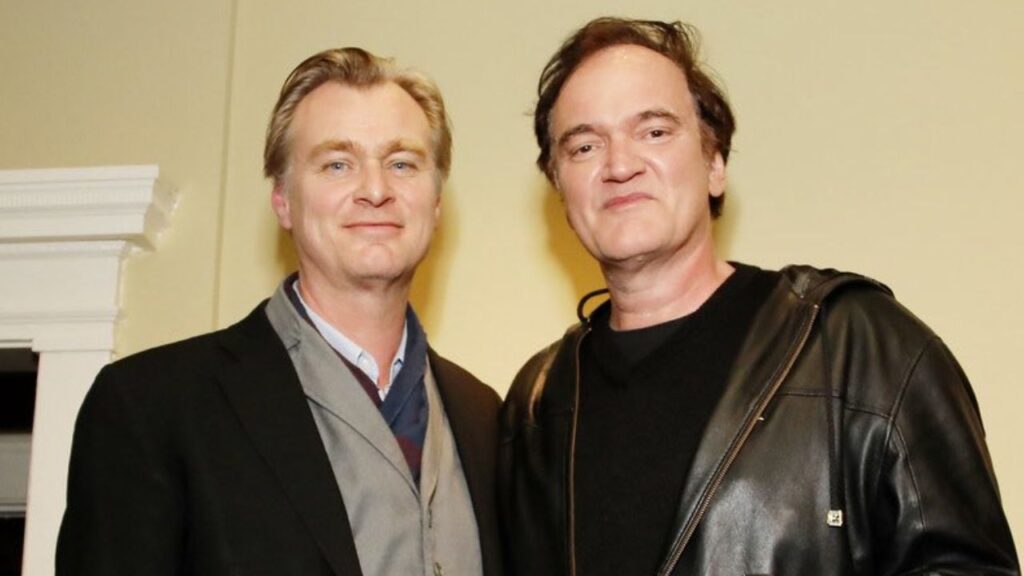
Quentin Tarantino’s long-standing plan to retire after directing his 10th feature film has once again become a major talking point in Hollywood. This time, it was fellow Oscar-winning filmmaker Christopher Nolan who weighed in on the decision, admitting he hopes Tarantino ultimately changes his mind. While respecting the director’s reasons for wanting to step away, Nolan believes every filmmaker should approach each project as though it could be their last rather than setting a fixed finish line.
The conversation has resurfaced as fans continue to wonder what Tarantino’s final movie will eventually be. After shelving The Movie Critic, the filmmaker has yet to announce the project that will become his tenth feature. Until then, speculation continues to grow, with many in the film industry questioning whether one of modern cinema’s most influential directors will really walk away from filmmaking.
Christopher Nolan shares his thoughts on Tarantino’s retirement plan
During a recent interview with The Telegraph, Christopher Nolan spoke candidly about Tarantino’s decision to cap his directing career at 10 feature films. Although he acknowledged that every filmmaker has the right to define their own creative journey, Nolan admitted he would rather see Tarantino continue making movies beyond that self-imposed milestone. According to the Oppenheimer director, focusing too much on a specific number can be limiting for an artist.
Explaining his perspective, Nolan said, “I think it’s dangerous to look at it that specifically. I mean, Quentin has his reasons, and I respect those enormously. But I’m hoping that he won’t stay true to them… I view every film that I do as the last I’ll ever make, and one day I will be right. So every time I want to put everything into the project at hand. I’m never thinking, ‘Well, I’ll save this for the next one.’ I don’t ever want to think like that. I want each movie to be everything.”
For Nolan, every film represents a complete creative commitment rather than another step toward a career milestone. His philosophy differs from Tarantino’s, as he prefers approaching each project without assuming another opportunity will follow. That mindset, he believes, encourages filmmakers to give everything to the story in front of them instead of holding back ideas for the future.
Nolan has questioned the idea before
This isn’t the first time Nolan has addressed Tarantino’s retirement plans. During the promotional campaign for Oppenheimer in 2023, he discussed the subject on the ReelBlend podcast, where he reflected on why Tarantino may have adopted such an approach. Nolan suggested that Tarantino’s thinking comes from his deep appreciation of film history and his desire to leave behind a consistently strong body of work.
Recalling that earlier conversation, Nolan said, “Quentin’s point has always been that — and he never, very graciously, he’s never specific about the films he’s talking about or whatever — but he’s looking at some of the work done by filmmakers in later years and feeling that if it can’t live up to the heyday, it would be better if it didn’t exist.” He went on to add, “And I think that’s a very purist point of view. It’s the point of view of a cinephile who prizes film history.”
Nolan also explained why he personally finds it difficult to judge whether a film deserves to exist simply because it may not rank among a director’s best work. “I’m not sure that I would trust my own sense of the absolute value of a piece of work to know whether or not it should have been brought into existence,” he said. He further added, “I’m a big fan, as is Quentin, of films that maybe don’t fully achieve what they try to, but there’s something in there that’s a performance, or a little structural thing, or a scene, you know, that’s wonderful. And so, yes, I understand. I think he wanted to keep a sort of perfect reputation of something, but also kind of don’t want to take anything off the table.”
Hollywood remains divided over Tarantino’s decision
Nolan isn’t the only acclaimed filmmaker to question Tarantino’s retirement strategy. Director Paul Thomas Anderson has previously admitted that he cannot imagine voluntarily stepping away from filmmaking after reaching a predetermined number of movies. For Anderson, directing is something he intends to continue for as long as he is physically and creatively able to do.
Speaking about the topic in an earlier interview, Anderson said, “I know Quentin [Tarantino] likes to say, ‘I’m making 10 movies and then I’m quitting.’ But I could never do that. I don’t know how he could say that, or how he could take himself seriously when he says that. This is what I want to do as long as I’m able to do it. As long as I’m able to do it, I’m going to do it.” While acknowledging that filmmakers should continue evolving with age, Anderson also suggested that creative longevity matters more than preserving a perfect filmography.
As for Tarantino himself, the filmmaker has remained committed to the idea of ending his directing career after one final feature. His cancelled project, The Movie Critic, was at one stage expected to become that farewell film before he decided to move in a different creative direction. Although his next movie remains under wraps, Tarantino isn’t stepping away from storytelling altogether. The filmmaker has already published bestselling books, and his stage play, The Popinjay Cavalier, is scheduled to open in London’s West End in 2027, ensuring his creative voice will continue even if he eventually leaves the director’s chair behind.