“He is more myself than I am.”
It’s one of the most devastating lines in Wuthering Heights, and it perfectly captures the contradiction at the heart of this adaptation. Love and rejection. Desire and destruction. Intimacy and distance.
Directed by Emerald Fennell, this reimagining of Wuthering Heights doesn’t treat the story as gothic romance. It leans into obsession — raw, erotic, and often feral. But while the ambition is undeniable, the execution doesn’t always hold steady.
Not a Love Story — A War of Desire
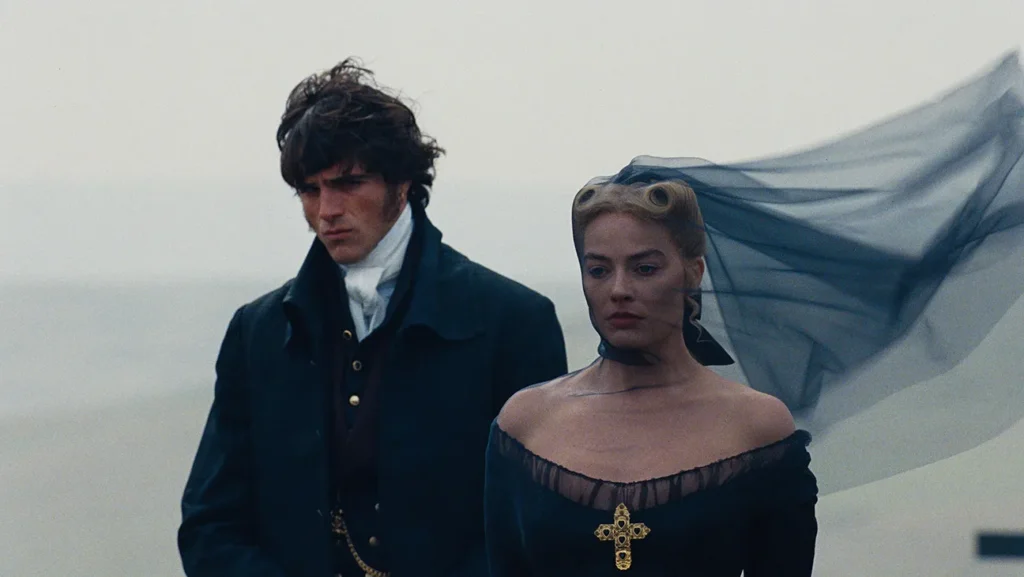
At its core, the film follows Catherine Earnshaw (played by Margot Robbie) and Heathcliff (played by Jacob Elordi), whose bond is less romance and more combustion.
This isn’t about lovers separated by fate. It’s about two people who reflect each other’s darkness — and then recoil from it.
Elordi’s Heathcliff is perhaps the most unhinged cinematic version yet. His rage feels internal, simmering, and occasionally explosive. Robbie’s Catherine, meanwhile, carries volatility beneath composure. She isn’t a tragic heroine waiting to be saved. She is as destructive as the man she claims to love.
And that’s where the film is most interesting — when it acknowledges that both are equally lethal.
A Screenplay That Doesn’t Let the Tragedy Breathe
Fennell’s script wants to be many things at once: erotic thriller, gothic opera, psychological character study. The problem is that it rarely settles long enough to fully explore any one of those lanes.
Moments build toward emotional devastation… and then abruptly shift. Tension crackles between Cathy and Heathcliff, only to dissolve before it can truly ignite. Narrative ideas are introduced and then quietly abandoned.
The pacing feels hurried. The tonal shifts are sharp. And while the film constantly brushes against greatness, it rarely allows itself to land there.
It’s beautiful chaos — but chaos nonetheless.
The Visual Poetry Is Undeniable
Where the film truly shines is in atmosphere.
Cathy’s mansion feels like a damp gothic dungeon, heavy with memory and resentment. In contrast, Edgar’s world — portrayed by Shazad Latif — is pristine, polished, almost artificial. His devotion borders on suffocating, painting walls to match Cathy’s complexion, obsessing over details to replicate her presence.
Suzie Davies’ production design grounds the film in tactile reality. The cold air, the mud, the texture of stone walls — you feel it. The cinematography captures this bleak beauty with precision, while Anthony Willis’ score hums beneath the drama without overpowering it.
Visually, the film is nearly flawless.
Emotionally, it feels restrained by its own rush.
Performances That Deserve More Space
Robbie and Elordi are committed. Robbie brings quiet menace to Catherine, especially in early scenes — including a chilling opening that frames her against the spectacle of a public hanging. It’s a bold introduction, suggesting a character capable of moral detachment.
But that psychological thread isn’t explored deeply enough.
Elordi leans fully into Heathcliff’s wounded pride and simmering fury. Yet the script rarely digs into the slow corrosion of his psyche. We are shown rage — but not always its gradual formation.
It’s not that the actors fall short. It’s that the film doesn’t give them enough room to expand.
The Fennell Factor
After films like Saltburn, Fennell has become known for blending elegance with provocation. Here, she attempts to reshape a literary classic into something erotic and psychologically volatile.
The intention is clear: this isn’t doomed romance. It’s toxic obsession.
But sometimes, style overtakes structure. The film feels like multiple drafts stitched together — visually cohesive, narratively fractured.
Final Verdict
This Wuthering Heights could have been a definitive modern adaptation. It has the cast, the craft, the ambition.
Instead, it becomes a haunting, aesthetically rich costume drama that moves too quickly to fully devastate. The tragedy is present — but it never quite settles into your bones.
It burns hot.
But it burns too fast.