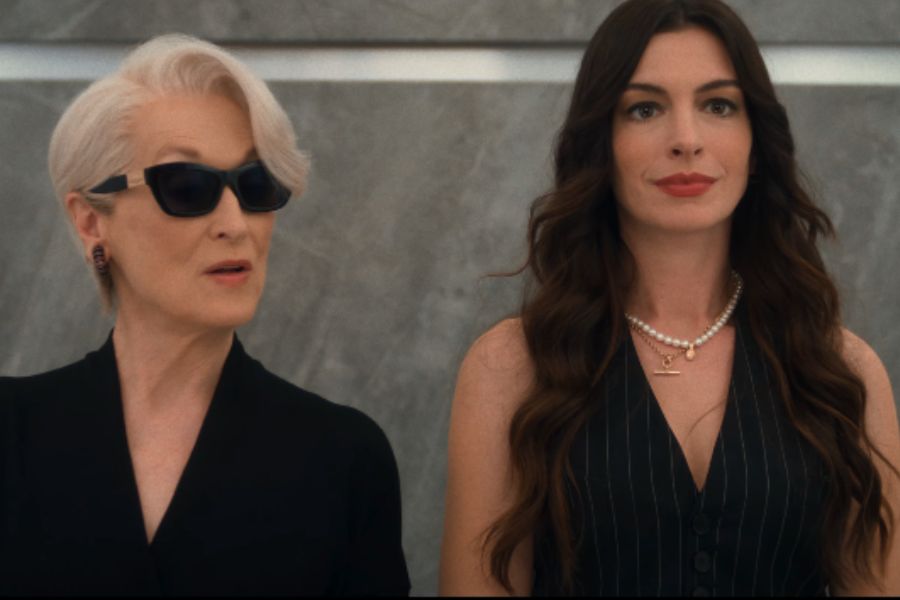
There was always going to be pressure on The Devil Wears Prada 2. Bringing back characters that audiences have loved for nearly two decades is not just about continuing a story, it’s about protecting a legacy. This sequel, directed by David Frankel and written by Aline Brosh McKenna, clearly understands that emotional weight. And yet, from the very beginning, it feels like the film is trying to walk a tightrope between giving fans what they remember and offering something new to hold on to.
The return of Anne Hathaway, Meryl Streep, Emily Blunt, and Stanley Tucci is easily the film’s biggest emotional hook. You feel that familiarity instantly, like stepping back into a world you once knew too well. But the real question quietly lingers underneath all that excitement — is this a natural continuation, or just a polished revisit built on memory?
A Story That Starts Strong But Feels Uneven Later
The film picks up years after Andrea Sachs walked away from Runway, choosing purpose over prestige. Now a respected investigative journalist at a major publication, she’s not chasing fashion anymore, she’s chasing truth. The opening stretch actually feels fresh, showing a version of Andy that has grown beyond the insecure assistant we once saw.
But then, things shift. A sudden job loss, a public meltdown, and a viral moment drag her back into the orbit of Miranda Priestly. The fashion world she once escaped pulls her in again, this time wrapped in controversy involving fast fashion and public image disasters. It’s dramatic, yes, but also slightly convenient, like the story is bending to reconnect the characters rather than letting them meet organically.
At the same time, the world of media has changed. Print is struggling, digital is ruthless, and reputation matters more than ever. The film touches on this shift, but never goes as deep as it could have. You get glimpses of something sharper, something more relevant, but it never fully commits.
Andrea Sachs Feels Different… But Not Fully Evolved
Andrea is no longer the awkward outsider trying to survive in high fashion. She’s confident, experienced, and carries herself with quiet authority. Anne Hathaway plays this version with ease, especially in moments where her frustration with the collapsing media industry shows through.
Still, something feels unfinished. Despite everything she has achieved, she continues to seek validation from Miranda, and that emotional loop starts to feel repetitive. Instead of pushing her character forward, the film often pulls her back into old patterns. It raises questions the script doesn’t fully answer, like why someone who has already proven herself still feels tied to that past approval.
There’s an interesting layer here, especially with the idea of her potentially exposing the darker side of her experiences. But the film hesitates, almost like it doesn’t want to challenge its own nostalgia too much. That hesitation ends up holding Andrea’s arc back.
Miranda Priestly Still Commands… But With Limits
Meryl Streep once again proves why Miranda Priestly remains unforgettable. The pauses, the expressions, the quiet control — it’s all still there. But this time, the character feels slightly restrained. In a world shaped by social media backlash and cancel culture, Miranda is forced to be more careful, more measured.
This change is both interesting and a little unsettling. Watching her hold back, choose softer words, and even adjust her behaviour adds a new dimension. At the same time, it slightly softens the edge that made her so iconic in the first place. She’s still powerful, still sharp, but not quite as untouchable as before. The introduction of her new assistant adds a modern layer, constantly reminding her of the consequences of every public move. It reflects today’s reality, but also changes the dynamic in subtle ways. Miranda isn’t feared in quite the same way — she’s watched.
Supporting Cast Brings Life Back Into The Film
If the film ever feels like it’s losing energy, it quickly finds it again whenever Emily Blunt or Stanley Tucci step in. Blunt, now positioned in a powerful role outside Runway, brings a sharper, more ambitious version of Emily that’s genuinely fun to watch. Her presence adds unpredictability, something the film needs. Tucci, on the other hand, remains the emotional anchor. His character still carries warmth, still acts as a quiet guide through all the chaos, and somehow manages to ground even the most dramatic moments. There’s comfort in his presence, and the film leans on that heavily.
New additions to the cast serve their purpose, but mostly exist to highlight Miranda’s world rather than stand out on their own. Some characters feel more like narrative tools than fully developed individuals, which makes certain parts of the story feel a bit one-sided.
Style, Nostalgia, And The Missing Magic
Visually, the film delivers exactly what fans expect. The fashion, the settings, the polished presentation — it all looks right. There’s no denying that the aesthetic still works, and in many ways, it feels like slipping back into a familiar, glamorous universe. But when you look beyond the surface, the emotional impact doesn’t hit as strongly as before. The original The Devil Wears Prada had a sharpness, a cultural bite that made it more than just a fashion film. This sequel tries to recreate that energy, but often settles for reminding you of it instead.
There are moments where it almost finds its own voice, especially when it touches on the realities of modern media and power dynamics. But those moments don’t fully come together. The film feels caught between being a tribute and being a new story, and never completely chooses one.
Final Take
The Devil Wears Prada 2 works best when you treat it as a reunion rather than a reinvention. It gives you the characters you loved, places them in a slightly updated world, and lets you spend time with them again. And for many viewers, that might be enough. But if you’re looking for something that truly expands the legacy or challenges it in a meaningful way, this sequel might feel a little restrained. It’s stylish, it’s familiar, and at times it’s genuinely enjoyable. Still, it never quite reaches the same level of impact that made the original unforgettable.