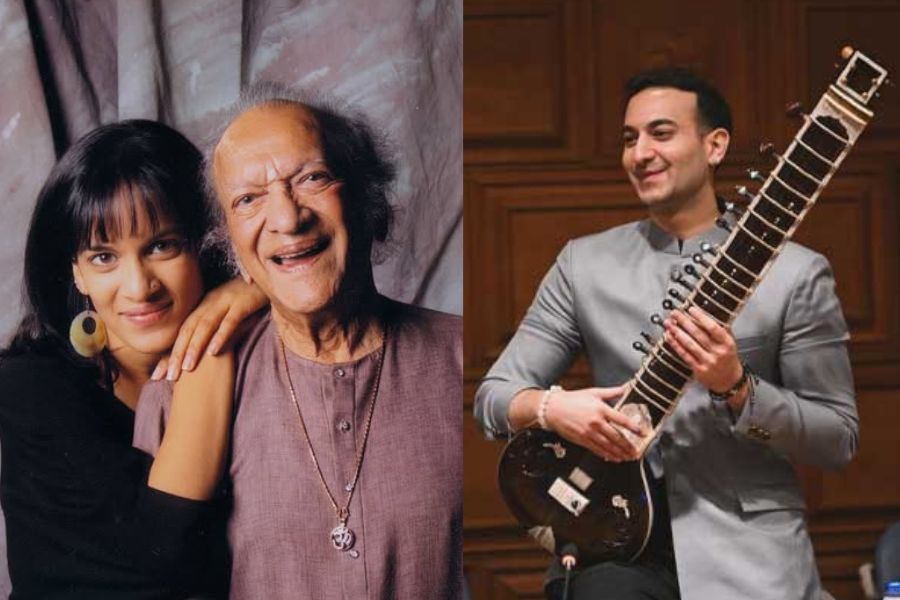
The debate around legendary sitar maestro Pandit Ravi Shankar and who can truly call themselves his disciple has taken a sharper turn. After Anoushka Shankar recently clarified that her father was never the guru of Rishab Rikhiram Sharma, the Ravi Shankar Centre has now issued a detailed statement laying out timelines, health records, and context to counter what it calls “inaccurate perceptions.”
The Centre’s note doesn’t just deny the claim — it reconstructs the final year of the maestro’s life to set the record straight.
What Really Happened in January 2012?
According to the Centre, on January 3, 2012, an informal string-tying ceremony took place at the Centre after persuasion from Rishab’s father. The gesture, they say, was affectionate and impromptu — not a traditional Ganda-Bandhan initiation.
There was:
- No priest
- No formal ceremonial thread
- No extended family gathering
- No formal discourse or long training session
Only Ravi Shankar, his wife, and senior disciple Parimal Sadaphal were present. The Centre claims that what was meant to be a small, informal moment has since been amplified far beyond its original intent.
The Kamani Auditorium Concert & Health Concerns
On February 10, 2012, Ravi Shankar attended one of Rishab’s performances at Kamani Auditorium — in a wheelchair. During his brief introduction, he reportedly said that the young musician had “just” become his student and had received “a few lessons.”
The Centre emphasizes a key detail: at no point did he publicly refer to Rishab as his disciple.
During that same event, Ravi Shankar’s health deteriorated significantly. Soon after, he was unable to provide meaningful instruction. Between January and March 2012, only a few classes were conducted, some jointly with Parimal Sadaphal, while additional training came from Arun Bharat Ram.
By March 9, 2012, Ravi Shankar had returned to the United States. After that date, the Centre states, there were no further lessons, phone calls, or supervision. The maestro passed away on December 12, 2012.
The implication is clear: claims of prolonged mentorship or ongoing guidance are, according to the Centre, factually incorrect.
What Does “Disciple” Really Mean?
In Indian classical music’s parampara tradition, the word “disciple” carries deep weight. The Centre stressed that discipleship is not symbolic or based on a brief association. It is forged over years of immersive training, guidance, and shared artistic commitment.
A handful of lessons or a concert introduction, they argue, does not equate to that lifelong bond.
They added that while Rishab may rightfully acknowledge having received a few lessons, the main guru under whom he trained deserves full credit.
Misdated Photographs & Viral Claims
The statement also addresses circulating photographs. One image allegedly taken on November 30, 2012, in Delhi has been flagged as inaccurate. The Centre states that on that date, Ravi Shankar was in San Diego, critically ill and preparing for hospitalization.
Other photos, they say, reflect a long-standing family relationship — as Rishab’s family were traditional instrument-makers associated with Ravi Shankar for generations — not proof of discipleship.
Who Were the Youngest and Last Disciples?
The Centre also dismissed the claim that Rishab was Ravi Shankar’s “youngest” or “last” disciple.
It named:
- Shubhendra Rao, who began training at age four and lived under the maestro’s guidance for nearly a decade.
- Anoushka Shankar, who began learning at age seven and later carried forward his global legacy.
As for his last disciples, the Centre cited Nishad Gadgil and Dr. Scott Eisman.
Why This Matters
Ravi Shankar wasn’t just a sitarist — he was a global cultural bridge who introduced Indian classical music to the world stage, collaborating with Western musicians and influencing generations. His discipleship tradition is seen as sacred, rigorous, and deeply personal.
So when claims arise about that legacy, the conversation naturally carries emotional and historical weight.
Final Words
This clarification from the Ravi Shankar Centre isn’t just about correcting a title — it’s about preserving the meaning of guru-shishya parampara.
In the world of Indian classical music, lineage matters. And as this controversy shows, so does accuracy.