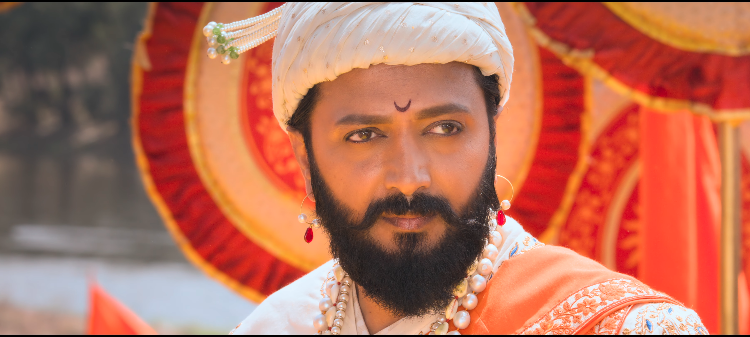
There’s something instantly powerful about telling the story of Chhatrapati Shivaji Maharaj on the big screen. The emotion comes built-in, the history already carries weight, and the audience walks in with a certain expectation. With Raja Shivaji, Riteish Deshmukh clearly understands that responsibility, and you can feel that sincerity right from the first frame. The film doesn’t try to be flashy for no reason, it leans heavily into respect and scale, and that’s where it finds both its strength and its limitation.
Releasing on Maharashtra Day, the film positions itself as more than just a biopic. It tries to be a full-fledged cinematic tribute rooted deeply in Maratha pride and identity. You can see the ambition in almost every scene, whether it’s the grand sets, the costumes, or the way certain moments are staged. But at the same time, the storytelling often plays it too safe, almost like it’s afraid to step beyond the known narrative.
The story begins even before Shivaji’s birth, focusing on Jijabai’s journey and the environment that shaped him. Bhagyashree as Jijabai brings a quiet strength, though the writing doesn’t always give her enough depth to truly explore that influence. As the narrative moves forward, we see Shivaji’s rise, his promise of Swarajya, and the many battles he faces, including the eventual confrontation with Sanjay Dutt as Afzal Khan. On paper, it covers all the key milestones, but the execution often feels like it’s ticking boxes instead of diving deeper.
What really works for Raja Shivaji is its scale and intent. Riteish, both as an actor and director, carries the film with visible dedication. This isn’t a casual attempt, it’s something he has clearly invested years into, and that effort shows. The production design is rich, the costumes feel authentic, and visually, the film does manage to transport you into that era. There’s a sense of grandeur that Marathi cinema hasn’t explored at this level very often, and that alone makes it stand out.
But once the initial impact settles, the film starts feeling a bit stretched. At 195 minutes, the runtime becomes noticeable, and not in a good way. The narrative moves steadily, but not always engagingly. There are long stretches where the film feels repetitive, sticking to a similar tone without offering emotional highs or cinematic moments that truly stay with you. Even major events, which should feel intense or dramatic, sometimes pass by without that expected punch.
Performance-wise, Riteish delivers with honesty. He doesn’t try to overdo the character, instead choosing a controlled and respectful portrayal. It works for the most part, though there are moments where you wish the character had more emotional layers. Genelia Deshmukh, playing Sai, brings warmth and softness to the film, and her scenes actually offer a refreshing break from the constant intensity. Their chemistry feels natural, even if it’s not explored as much as it could have been.
The supporting cast has its highs and lows. Abhishek Bachchan tries to bring weight to his role, especially in action sequences, but struggles slightly with emotional expression in certain scenes. Sanjay Dutt’s Afzal Khan, which should have been a major highlight, surprisingly lacks the menace needed to make the conflict feel truly gripping. On the other hand, Vidya Balan in a brief role leaves an impression despite limited screen time.
One of the biggest missed opportunities is how the film handles its emotional core. Shivaji’s journey wasn’t just about battles and strategy, it was also about relationships, influence, and inner conflicts. The film touches on these aspects but never fully explores them. Jijabai’s role feels underwritten, and the romantic track, though sweet, remains on the sidelines. It’s like the film chooses action and scale over depth almost every time.
There’s also a noticeable pattern where the film stays on the surface of history instead of digging into lesser-known or more complex moments. Everything feels correct, respectful, and visually accurate, but not always deeply engaging. It follows the rulebook of historical storytelling without taking creative risks that could have made it more memorable.
In the larger picture, Raja Shivaji is still an important film for Marathi cinema. It proves that big-scale historical dramas can be mounted with ambition and technical strength. But as a storytelling experience, it doesn’t fully match that scale. It remains a sincere tribute, a well-intentioned effort, but one that doesn’t hit the emotional or cinematic highs it aims for.
And yes, there’s a cameo by Salman Khan that might get a reaction in theatres, but it doesn’t really add much beyond that moment. In the end, Raja Shivaji feels like a film made with heart and respect, but held back by its own cautious approach. It honors the legacy it’s built on, but doesn’t quite transform it into a gripping cinematic experience.