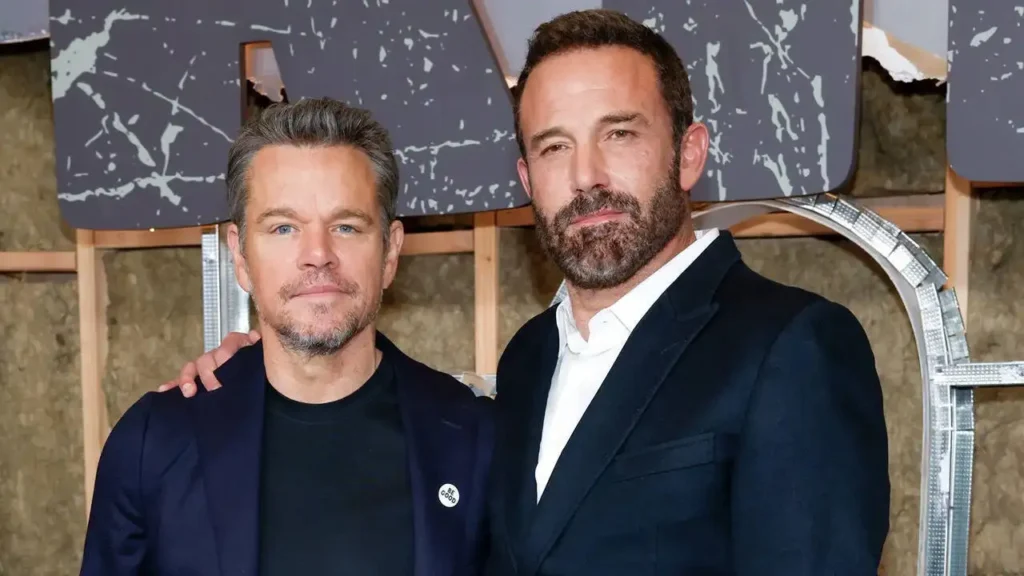
Longtime collaborators Matt Damon and Ben Affleck aren’t holding back when it comes to how streaming is changing filmmaking. While promoting their upcoming Netflix film The Rip on The Joe Rogan Experience, the duo offered a candid look at the creative compromises — and contradictions — that now shape big-budget movies made for home viewing.
Why Netflix wants action fast — and repeated
Damon explained that audiences simply watch films differently at home than they do in theatres. With distractions everywhere, streamers like Netflix want filmmakers to hook viewers immediately — sometimes within the first few minutes.
According to Damon, this has led to behind-the-scenes conversations about front-loading action sequences and repeating key plot points multiple times in dialogue, all to account for viewers scrolling on their phones while watching.
He contrasted this with the traditional action-movie formula they grew up with: three major set pieces spread across the film, with the biggest and most expensive sequence reserved for the finale. That structure, Damon suggested, is no longer the default for streaming-first projects.
Affleck pushes back — and names an exception
Affleck was quick to point out that the streamer playbook isn’t the only path to success. He cited Netflix’s limited series Adolescence as proof that audiences will still engage with slower, more restrained storytelling.
Calling the show “great,” “dark,” and emotionally intense, Affleck highlighted how Adolescence avoids flashy tricks altogether. Long silences, minimal dialogue, and scenes that linger — even shots where characters say nothing — are exactly the kind of choices streaming algorithms often warn against.
Yet the series became a breakout hit anyway.
Two philosophies colliding
Damon acknowledged that shows like Adolescence may be the exception rather than the rule, but Affleck disagreed. In his view, the series demonstrates that filmmakers don’t have to rely on constant action beats or repeated exposition to hold attention — even on a platform built around retention metrics.
The exchange underlined a growing tension in Hollywood: balancing data-driven storytelling with creative instincts, especially as streaming platforms increasingly shape how movies are written, edited, and paced.
Final words
Damon and Affleck’s conversation wasn’t a rejection of Netflix — far from it. Instead, it was an honest snapshot of an industry in transition, where attention spans, algorithms, and artistry are constantly negotiating for control. And if Adolescence is any indication, audiences may still be willing to slow down — when the storytelling is strong enough.