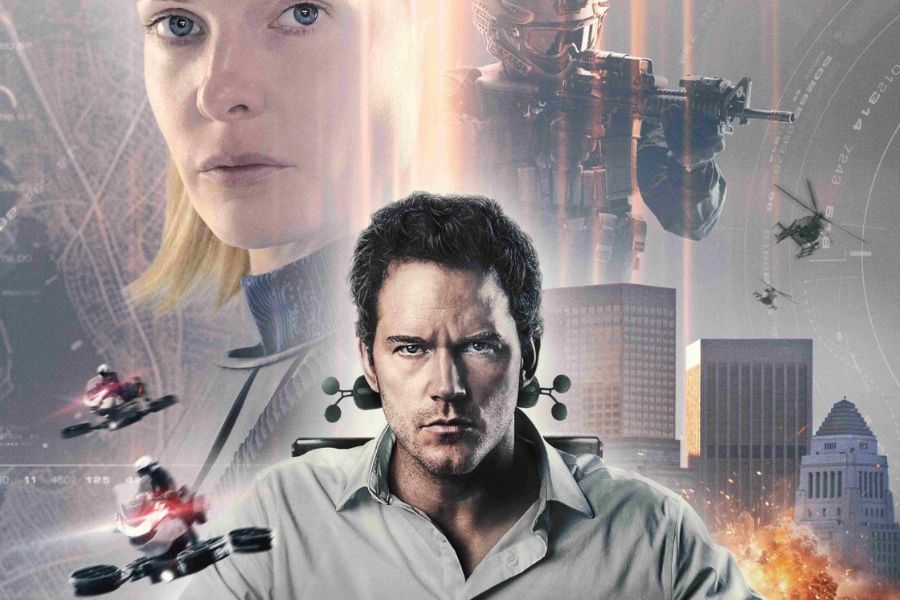
Mercy arrives with a timely question that feels ripped straight from our current moment: is artificial intelligence here to save us, or silently sentence us? On paper, the premise sounds sharp, urgent, and unsettling. A justice system run entirely by algorithms. Guilt measured in percentages. Mercy reduced to a data point. Unfortunately, while the idea is strong, the execution never quite catches up.
Headlined by Chris Pratt and Rebecca Ferguson, Mercy positions itself as a real-time sci-fi thriller with philosophical ambition. What it ultimately becomes is a watchable but confused film, torn between being a thinking person’s cautionary tale and a loud, chaotic action ride.
The Setup: Justice by Algorithm
Set in Los Angeles in 2029, Mercy imagines a world where the justice system has handed over the final word to artificial intelligence. Courts are obsolete. Judges are code. Verdicts are calculated, not debated.
Chris Pratt plays Chris Raven, a troubled LAPD detective grappling with alcoholism and a murky past. After a blackout night, Raven wakes up to a nightmare scenario — he’s accused of murdering his wife. With no memory of the crime and no human jury to appeal to, he is placed inside the Mercy program, an experimental AI-driven system where defendants are presumed guilty until proven innocent.
Raven is strapped into a high-tech interrogation chamber and given a brutal ultimatum: he has 90 minutes to prove his innocence. If the AI’s probability model doesn’t reach 94 percent in his favour, execution follows automatically.
Standing between him and survival is Judge Maddox — an AI enforcer projected as a chilling hologram, voiced and embodied by Rebecca Ferguson.
Where the Film Hooks You
The early stretch of Mercy works surprisingly well. The real-time format creates urgency, the ticking clock adds pressure, and the idea of guilt being quantified feels genuinely unsettling. The film smartly raises questions about efficiency versus empathy, and whether justice without human judgment is justice at all.
As Raven digs through fragmented memories and suppressed truths, the story flirts with being a tight psychological thriller. There’s satire here too — a subtle dig at society’s blind faith in “objective” systems that may inherit human bias without human accountability.
For a while, Mercy feels like it knows exactly what it wants to say.
Performances: One Clear Standout
Chris Pratt brings his familiar charm and relatability to Raven. He makes the character easy to root for, even when Raven’s flaws are front and centre. Panic, guilt, and desperation come through clearly, but the script rarely gives Pratt enough emotional depth to fully explore those layers. There’s a sense that this could have been a career-shifting role — if only the writing trusted him more.
Rebecca Ferguson, however, is on another level. As Judge Maddox, she is cold, composed, and quietly terrifying. Her calm authority and controlled delivery elevate every scene she’s in, making the AI feel more human than most of the humans around her — which is perhaps the film’s most unintentionally effective idea.
The supporting cast does what it can, but most characters are thinly written and largely functional, existing only to move the plot forward.
Where It Loses Control
Midway through, Mercy begins to wobble. The sharp philosophical tension slowly gives way to louder action beats, and the film starts contradicting itself. Is it a critique of algorithmic justice, or an excuse for stylised mayhem? Is it asking us to think, or just asking us to keep watching?
The final act leans heavily into chaotic action and near-absurd escalation, diluting the moral questions it worked so hard to set up. What began as a tense, cerebral thriller ends as something far more conventional — and far less interesting.
The shift in tone feels rushed and unresolved, leaving the film stranded between two identities.
What Worked / What Didn’t
What worked
- A timely, provocative core idea
- Rebecca Ferguson’s commanding performance
- A strong, suspenseful first half
- An unsettling real-time setup
What didn’t
- Confused tone and uneven pacing
- Underwritten supporting characters
- A climax that sacrifices ideas for spectacle
Final Verdict
Mercy is a film that asks important questions but doesn’t sit with them long enough. It’s neither a disaster nor a standout — just a slightly frustrating “almost.” The concept is sharp, the performances are capable, and the world feels plausible, but the storytelling lacks the conviction to follow its ideas through.
Chris Pratt does solid work, Rebecca Ferguson elevates the material, and the film remains engaging enough to finish. But by the end, Mercy feels less like a warning about AI-driven justice and more like a missed opportunity.
Thought-provoking in parts, muddled in others, Mercy works best as a speculative cautionary tale — not the definitive AI thriller it clearly wanted to be.
Rating: ⭐⭐⭐ / 5
🍿 Watch it for the concept and Ferguson’s performance — just don’t expect answers.