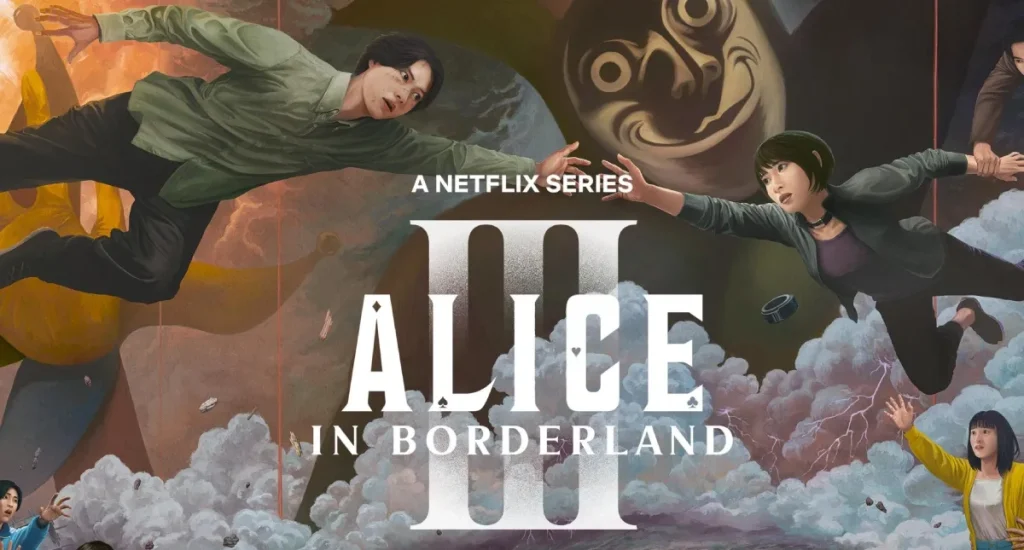
Alice in Borderland Season 3 returns with more intensity, mind games, and emotions than ever before. This Netflix Japanese thriller, based on Haro Aso’s manga, has managed to create its own identity in the world of survival dramas. After two explosive seasons full of puzzles, betrayals, and mysterious characters, this new season dives even deeper into the twisted reality of the Borderland — a place where the line between life and death is blurred, and where every card could decide your fate.
The show picks up right where season 2 left off. Arisu and Usagi finally thought they had beaten the games after defeating the final face cards, especially the Queen of Hearts. But peace in Borderland doesn’t last long. As they wake up thinking they are back in the real world, something feels off — the city is eerily quiet, people act strange, and there are new symbols replacing the cards. It’s clear that the nightmare isn’t over yet. Season 3 explores what really lies beyond the deck — and who is truly behind the creation of Borderland.
Cast and Performances
Kento Yamazaki once again takes the spotlight as Arisu, giving one of his most layered performances yet. His mix of vulnerability and determination makes him the emotional heart of the show. Tao Tsuchiya as Usagi continues to shine as his partner in both survival and emotion. Her character has evolved from a lone survivor into a woman who believes in hope and connection, even when everything seems hopeless.
Other returning characters include Niragi (Dori Sakurada), who somehow survived and brings back his twisted sense of humor and danger, and Chishiya (Nijiro Murakami), the cunning and calm player who always seems two steps ahead. The chemistry between these actors brings a perfect balance of chaos and calm, trust and betrayal.
New faces are introduced too, including a mysterious figure named Reina (played by Ayami Nakajo), who claims to know the truth about Borderland and holds knowledge of the “origin game.” Her arrival changes the entire direction of the story. There’s also Takuma (Kentaro Ito), a former game master who might be hiding a deeper connection to Arisu’s past.
Synopsis and Storyline
Season 3 begins with what seems like a happy ending. Arisu wakes up in a hospital, surrounded by people who also survived. But something feels wrong — some of the survivors have no memory of the games, and some locations from Tokyo are mysteriously distorted. Soon, strange black suits appear in the sky, announcing that a new set of games has begun — “The Jokers’ Game.”
This new arc focuses on the Joker cards, which were teased at the end of Season 2. Unlike the previous card-based games that represented physical, psychological, or team-based survival, the Joker’s realm mixes all of them. These games are unpredictable, bending the rules of time and reality. One episode might trap players in a memory maze, while another could force them to relive their worst fears.
Arisu and Usagi are once again pulled into the madness, but this time, the emotional tension is heavier. Arisu starts questioning if Borderland was ever a separate world — or if it’s something inside the human mind. The writers cleverly blur the boundaries between illusion and reality, making viewers doubt everything they see.
The highlight of the season is the third game, known as “The Mirror of Self.” Each player faces a version of themselves that reflects their guilt and trauma. This episode hits hard emotionally, especially when Arisu sees his parents again and must decide whether to stay with them or keep fighting to return to reality. It’s one of those moments that make the show feel more like a philosophical reflection than just a survival thriller.
Usagi’s arc also grows beautifully this season. After years of being haunted by her father’s death, she finally learns the truth about his research — that he was connected to the creation of the Borderland experiment. Her emotional breakdown and final confrontation with Reina are among the season’s most powerful moments.
Meanwhile, Chishiya and Niragi’s dynamic turns from enemies to uneasy allies. They both understand that this version of Borderland isn’t controlled by humans anymore — it’s controlled by something beyond comprehension. Their storyline gives a lot of dark humor and clever dialogues, balancing the tension with a touch of unpredictability.
As the episodes progress, the truth slowly unfolds. Borderland was not just a parallel dimension — it’s revealed to be a collective consciousness of people near death, a limbo between life and afterlife. But in Season 3, it’s no longer just a waiting room — it’s evolving. The Joker, an unseen entity, represents chaos itself — a test to see if humanity can find meaning in endless suffering.
The final two episodes are a rollercoaster of emotions. The players must face one last game called “Reset,” where they are forced to decide whether to destroy Borderland completely or let it continue for others trapped between life and death. Arisu chooses to sacrifice himself, believing that hope must be given to those still lost. But in a twist ending, he wakes up again in the real Tokyo — only to find a Joker card lying on the hospital table. The smile he gives before the camera fades to black suggests that the game might never truly end.
Direction and Visuals
Visually, Season 3 is stunning. The cinematography captures Tokyo in haunting beauty — empty streets, foggy skies, neon-lit ruins, and surreal landscapes that feel both dreamlike and terrifying. The CGI has improved a lot, especially in the large-scale game sequences. The “Joker Tower” episode, where players navigate an ever-changing skyscraper, is one of the most visually creative moments of the series.
The music continues to deliver that perfect balance of tension and melancholy. The slow piano tracks during emotional scenes blend beautifully with the intense electronic beats in the action sequences. Every sound, every silence, seems perfectly placed to build the tension.
Themes and Emotions
What makes Alice in Borderland stand out isn’t just the survival aspect — it’s the humanity beneath it. Season 3 dives deep into questions about life, death, and purpose. Arisu’s philosophical transformation shows how trauma, guilt, and loss can either destroy a person or help them grow stronger.
The theme of connection is stronger than ever. While previous seasons were about survival and logic, this one is about emotion — how love, friendship, and hope can break even the cruelest cycle. The show also questions whether true freedom can exist without suffering.
There’s a beautiful irony running through the story — that even in a world built on death, people learn what it really means to live.
Final Thoughts
Alice in Borderland Season 3 is a thrilling and emotional continuation that delivers both action and heart. It doesn’t just aim to shock or confuse — it wants you to think, to feel, and to question. While some parts might feel slow or overly symbolic, the overall payoff is worth it.
The ending leaves room for another season or even a movie, but it also works as a satisfying conclusion to Arisu’s journey. The performances are top-notch, the story hits both mind and heart, and the visuals keep you glued to the screen.
It’s not a perfect season — some side characters disappear too quickly, and a few twists feel forced — but it captures the same magic that made Season 1 special while adding deeper meaning.
If you loved the earlier seasons, Season 3 will not disappoint. It’s darker, smarter, and more emotional, showing that even in a world full of death, the human heart keeps beating — searching for something real in the middle of chaos.
Rating: 8.8/10 – A hauntingly beautiful conclusion to a deadly game.