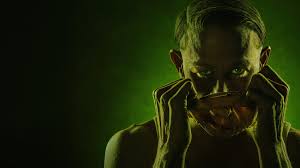
When Netflix first announced Monster: The Ed Gein Story (Season 1), fans of true crime and dark psychological drama knew they were in for something both fascinating and disturbing. Following the huge success of Monster: The Jeffrey Dahmer Story, Ryan Murphy returns once again with another deep dive into the twisted mind of one of America’s most infamous killers—Ed Gein, the so-called “Butcher of Plainfield.” This season, instead of glamorizing the killer, it tries to explore the lonely and horrifying world that created him. It’s gritty, slow-burning, and chilling in a way that makes you uncomfortable yet unable to look away.
Cast and Performances
The casting for Monster: The Ed Gein Story is nothing short of brilliant. The main role of Ed Gein is played by Evan Peters once again, who delivers a haunting performance filled with quiet madness and inner confusion. He doesn’t play Gein like a monster, but as a broken man molded by years of emotional abuse and isolation. His awkwardness, his empty stares, and those moments where he seems almost childlike—make the performance uncomfortably real.
Jessica Lange returns as Augusta Gein, Ed’s overbearing and religiously fanatical mother. She steals every scene she’s in. Her portrayal of Augusta is terrifying yet tragic—she’s a woman consumed by her faith and paranoia, believing that every woman except herself is a sin waiting to happen. Her constant yelling, prayers, and manipulation create the toxic environment that shapes Ed’s entire life.
Supporting cast includes Michael Shannon as Sheriff Schley, the local lawman trying to piece together the bizarre crimes in Plainfield, and Sarah Paulson as Mary Hogan, one of Ed’s victims who appears through haunting flashbacks and dreamlike sequences.
Every actor seems fully absorbed in this grim, rural 1950s Wisconsin setting. The cold, gray cinematography and slow pacing only add to the unsettling realism.
Synopsis
The show begins not with murder, but with silence. Episode 1 opens on the snowy plains of Plainfield, Wisconsin, showing Ed Gein tending to his decaying farmhouse and speaking to his dead mother’s rocking chair. The first episode is quiet, uncomfortable, almost sympathetic, letting us live inside Ed’s small, broken world. We see his daily routine—fixing things, visiting the general store, being mocked by the townsfolk. Everyone thinks he’s just the “weird guy,” harmless, a little off, but not dangerous.
But soon, the cracks start to show. We get flashbacks of his childhood where his mother Augusta forced him to read Bible verses about sin and punished him for even looking at women. His father is shown as a drunk, his brother as the only one who ever dared to stand up to Augusta—and mysteriously dies in a fire, which the show strongly hints wasn’t an accident.
As the season goes on, Ed becomes increasingly detached from reality. He keeps his mother’s room untouched after her death, talking to her spirit, hearing her voice commanding him to “cleanse the town of sinful women.” He starts robbing graves, first out of grief, then obsession. He tries to bring his mother “back” by collecting body parts, creating a horrifying shrine made from human remains.
The show doesn’t rush the horror. It builds slowly, giving you small glimpses of Ed’s twisted imagination. There are moments where you almost pity him—a man trapped between loneliness and insanity—but then the camera pans to a lampshade made of human skin, and all pity turns into pure disgust.
By Episode 5, the tension explodes. The disappearance of Bernice Worden leads to Ed’s arrest. The discovery of her mutilated body and the collection of human remains in his farmhouse shocks even the most hardened police officers. The final episodes focus on Ed’s interrogation, where he confesses almost casually, describing his crimes as if they were chores. “I just wanted company,” he says in one chilling scene.
The finale doesn’t glorify him. Instead, it leaves viewers questioning whether Ed was evil by choice or molded by his mother’s madness. The show ends quietly, showing the farmhouse being burned down and Ed staring blankly through a hospital window, humming an old hymn his mother used to sing. No dramatic music, no speeches—just emptiness.
Storyline and Themes
Monster: The Ed Gein Story isn’t just about murder—it’s about control, trauma, and what happens when isolation turns into obsession. It’s less of a slasher and more of a psychological horror. Each episode slowly dissects Ed’s relationship with his mother, showing how love turned into control and how religion became a weapon.
There’s a deep focus on the small-town setting too. Plainfield is shown as a place where everyone knows each other, yet no one really sees what’s happening behind closed doors. The show highlights how society often ignores mental illness, especially in isolated communities. Ed’s odd behavior, his obsession with his dead mother, his strange visits to the cemetery—all were brushed off as “harmless weirdness” until it was too late.
The writing does a good job showing the blurred line between victim and monster. Ed is both a product of abuse and the creator of unspeakable horror. The scenes between him and Augusta are some of the best written in the series—uncomfortable, almost suffocating. You feel the emotional cage he grew up in.
There are also philosophical undertones—about faith, sin, guilt, and the human need for companionship. At times, Ed seems like a lost child searching for his mother in all the wrong ways. The show asks if he was born evil or if evil was taught to him, one prayer and one punishment at a time.
Direction and Tone
Ryan Murphy’s direction keeps the series stylistically consistent with Monster: Dahmer, but darker in tone. The colors are washed out—mostly browns, grays, and faded greens. The camera often lingers too long, forcing the audience to sit in discomfort. There are almost no jump scares; instead, the fear comes from what’s not shown, from the silence, from Ed’s quiet humming or the creak of a floorboard in the farmhouse.
The soundtrack is minimal, filled with eerie hymns and vintage radio songs that contrast with the horror on screen. The editing is slow, sometimes painfully so, but it works. It’s like watching rot spread slowly through wood—you can’t stop it, you just watch it consume everything.
One thing some viewers might find frustrating is the pacing. The middle episodes drag a little, focusing too much on Ed’s routine and inner thoughts. But others may appreciate that—it gives time for the psychological horror to breathe.
Impact and Emotional Effect
Watching Monster: The Ed Gein Story is not entertainment in the traditional sense—it’s an experience. It leaves you drained, disgusted, yet oddly reflective. The series doesn’t use gore for shock value, but the few violent scenes it does have are almost unbearable because of how real they feel.
It also humanizes the victims in a way true crime often fails to do. Through dreamlike flashbacks and personal moments, we see the women Ed targeted not as nameless bodies, but as people who laughed, worked, and lived. It’s a subtle but powerful reminder of the real cost of these crimes.
By the end, you don’t feel fascination for Ed—you feel pity and fear. Not fear of him, but fear of how easily such monsters can be created by neglect, abuse, and ignorance. It makes you think about how mental illness and isolation, if left untreated, can twist a person beyond repair.
Final Thoughts
Monster: The Ed Gein Story (Season 1) is a disturbing, emotionally heavy show that digs deep into the darkness of the human mind. It’s not for everyone—some will find it too slow, too unsettling, or even too depressing—but that’s kind of the point. It’s not supposed to entertain; it’s supposed to haunt you.
The performances, especially from Evan Peters and Jessica Lange, are masterclass level. The direction is hauntingly quiet, and the writing balances sympathy and horror perfectly. The show doesn’t justify Gein’s actions, but it tries to understand them, and that’s what makes it powerful.
If you have the stomach for something dark, slow, and emotionally complex, Monster: The Ed Gein Story is a must-watch. But be warned—once you’ve seen Ed Gein’s world, it’s hard to forget it.
Rating: 8.5/10 – Disturbing, brilliant, and deeply human in the most horrifying way.