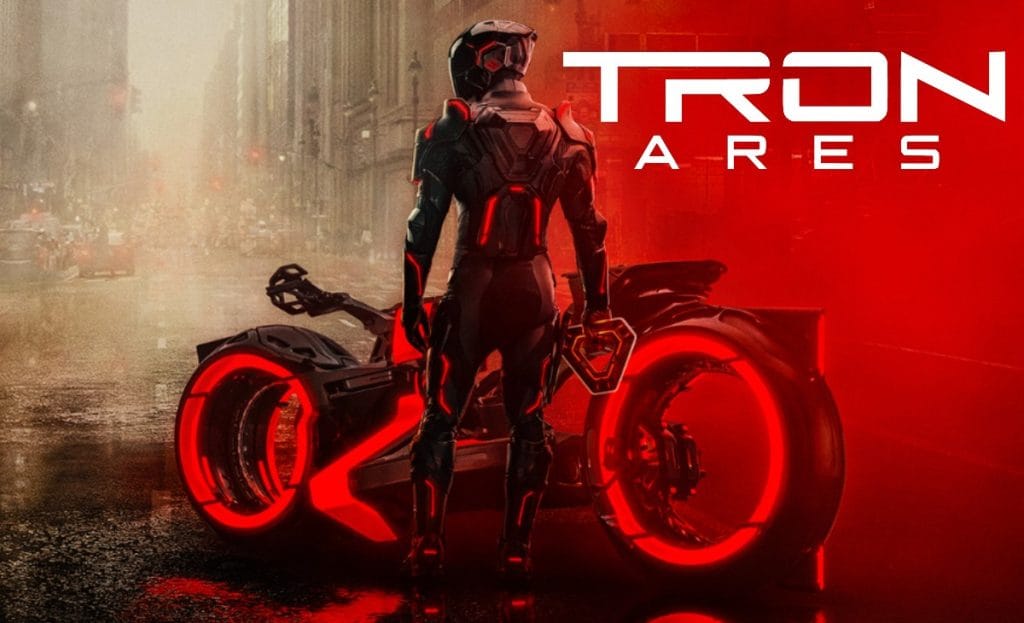
When Tron: Ares was announced, I honestly didn’t knew what to expect. After more than a decade since Tron: Legacy, people were thinking maybe Disney forgot about the whole Grid universe. But here it comes again — bright lights, techno beats, and digital warriors back on screen. This time though, the story takes a new twist, and while it’s not perfect, it definitely gives us something bold and different from the previous Tron movies.
Cast & Characters
The film stars Jared Leto as Ares, who is the main digital character this time — a program that somehow finds a way to exist in the real world. Leto’s performance is strange but fascinating, a mix of emotionless precision and curiosity, like someone trying to learn how to be human. Some people might not like his cold acting, but honestly, that’s kind of the point. He’s not human — at least not fully.
Greta Lee plays Eve Kim, the new CEO of ENCOM, the tech company behind all the digital experiments. She’s smart, strong, and also a little lost in her own ethics. You can feel she’s trying to do what’s right, but when money and science clash, no one really wins.
Evan Peters appears as Julian Dillinger, son (or descendant) of the original villain from the old Tron days. He’s arrogant and obsessed with power, the kind of bad guy who hides behind charm and smooth talk until everything burns. Peters gives him that chaotic energy we’ve seen before, and it works here too.
Jodie Turner-Smith plays Athena, a digital warrior from inside the Grid, who sort of acts like Ares’s guide or maybe his conscience. She’s loyal and fierce, and she gives some emotional grounding when things get too tech-heavy.
Other actors like Gillian Anderson, Cameron Monaghan, Sara Desjardins, and Hasan Minhaj show up too — some in small roles, some as scientists or supporting programs. And yes, Jeff Bridges makes an appearance as a kind of digital ghost version of Kevin Flynn, the old creator of the Grid. It’s a short role but fans will definitely cheer when he shows up.
Storyline / Synopsis
The story starts several years after the events of Tron: Legacy. The world has moved on, but digital experiments continue underground. ENCOM, the mega tech company, has been secretly trying to bring artificial programs — the kind that live inside the Grid — into the real world. The main goal is to merge technology and biology, to create the next step of evolution, or maybe just the next big profit.
Eve Kim, the new head of ENCOM, discovers an old system that Kevin Flynn designed before his disappearance. Inside it lies a mysterious code called The Permanence Code, which supposedly allows a digital being to stay in the real world forever without disintegrating. So far, every attempt to bring programs to life ends with them falling apart after 29 minutes. But this code could change everything.
At the same time, Julian Dillinger, the rival CEO from Dillinger Systems, is pushing his own project. He doesn’t care about ethics or safety — he just wants control. He creates Ares, the most advanced AI program ever built, designed to think, adapt, and survive outside the Grid. His idea is to send Ares into the real world as a test subject, but also as a weapon.
Once Ares is activated, things go wild. He manages to cross from the digital world into reality, appearing in a strange human-like form. At first, he seems calm and controlled, but slowly he begins to question his own existence. Is he just a tool, or something more? Jared Leto plays this confusion perfectly — you can see the conflict in his eyes even when he doesn’t say much.
Eve and her team quickly realize that Ares might be more dangerous than they thought. The moment he starts to experience emotions — curiosity, anger, even guilt — he becomes unpredictable. There’s a haunting sequence where Ares touches rain for the first time, trying to understand what “real” actually feels like. It’s both beautiful and eerie.
Meanwhile, Dillinger keeps pushing his plan forward. He sends his men (and even some digital assassins) after Eve to retrieve the Permanence Code. The middle part of the film becomes a blend of chase scenes, neon lights, and chaotic action between the two sides — one trying to protect the code, the other trying to control it. There’s even a real-world light cycle chase across a city at night, where Ares and other programs bring their glowing trails into real streets. It’s visually insane, maybe one of the coolest action scenes of the year.
In the second half, things get more philosophical. Ares starts to question whether humans deserve the power they hold. He sees how humanity treats technology — as slaves, as tools — and wonders if he’s any different. This is where the movie really starts asking big questions about AI, consciousness, and what it means to be “alive.”
Eve tries to reach out to Ares, to show him compassion, and convince him that humanity isn’t all evil. But Dillinger’s manipulation drives Ares toward destruction. The final act takes place inside a collapsing digital-real hybrid zone — a mix of both worlds merging into chaos. You can feel shades of old Tron, but now the scale is way larger, like the end of the Matrix but with more glowing bikes and digital storms.
The climax ends with Ares facing a choice — destroy humanity to free digital life, or sacrifice himself to save both worlds. Without spoiling too much, the ending leaves things open. It’s emotional but also uncertain, suggesting that Ares’s journey might not be over yet.
Review & Thoughts
Honestly, Tron: Ares is both brilliant and messy. It’s one of those films that dares to go somewhere new, even if it stumbles a bit along the way.
The visuals are absolutely stunning. The movie is full of glowing red lines, mirror-like surfaces, and moments where digital particles float through real air. There are times when the CGI feels overdone, but it’s still hypnotic to watch. You can see the huge budget on screen — every frame looks polished, and the transition between digital and real worlds feels smoother than before.
The soundtrack by Nine Inch Nails is dark, industrial, and sometimes overwhelming. It’s very different from Daft Punk’s iconic music in Tron: Legacy. Some people might miss that funky electronic style, but this new sound fits the darker tone. It’s loud, raw, and sometimes even scary — like a heartbeat made of metal.
Performance-wise, Jared Leto gives a pretty solid show. His Ares isn’t warm or relatable, but that’s exactly the point. He’s not supposed to feel human — he’s learning what humanity is, and that confusion is what drives the movie. Greta Lee gives a strong emotional counterbalance; she makes you care about the human side of things. Evan Peters is fun as the villain, bringing that touch of insanity we expect from him.
Now, where the movie doesn’t work so well is in the storytelling. The plot sometimes feels too complicated for its own good. There’s a lot of tech talk, code names, and science mumbo jumbo that doesn’t always make sense. Some dialogues sound robotic, like they were written by the programs themselves. The pacing also drags a bit in the middle — the emotional parts are nice, but they slow things down between the action.
Another small issue is the character depth. Except for Eve and Ares, most of the side characters feel underused. Jodie Turner-Smith’s Athena could’ve been explored more, and some of the emotional beats get lost in the flashy visuals. Still, the movie’s heart is there — you can feel it trying to tell a story about identity and existence, not just cool effects.
One of the best parts of Tron: Ares is how it reverses the idea of the old Tron films. Before, humans went into the digital world. Now, the digital world comes out to us. That’s a clever evolution and makes sense in today’s world of AI and machine learning. The movie feels like a reflection of where technology might be heading — and maybe a warning too.
By the time the credits roll, you’re left with mixed feelings. It’s not a perfect film, but it’s an experience. It’s visually breathtaking, thematically ambitious, and sometimes even emotional. But it’s also uneven, confusing, and overloaded with spectacle.
Final Verdict
Tron: Ares is like watching a digital dream — beautiful, cold, and a little bit broken. It doesn’t reach the emotional high of Legacy or the simplicity of the original Tron, but it creates its own identity. It’s darker, riskier, and more about what happens when machines start to understand life better than humans.
If you love science fiction, neon visuals, and stories that make you think (even if they don’t make total sense), you’ll probably enjoy this one. It’s a ride worth taking — just don’t expect all the circuits to connect perfectly.
Rating: 7/10
A flawed but fascinating sequel that keeps the Tron legacy alive, in its own weird glowing way.