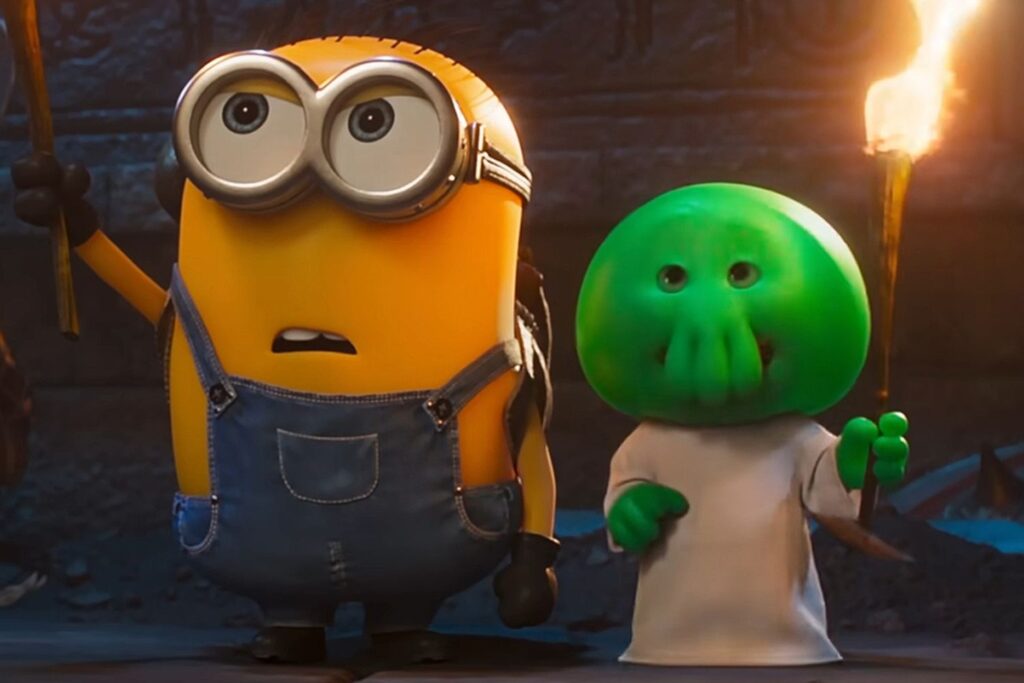
Nearly two decades after they first stumbled their way into pop culture, the Minions have finally found a story that feels tailor-made for their peculiar brand of chaos. Minions & Monsters doesn’t just send the yellow troublemakers on another globe-trotting adventure. Instead, it drops them into one of the most fascinating periods in movie history, the moment when silent films gave way to talking pictures. What sounds like an odd idea on paper turns out to be the franchise’s most inspired concept in years.
The result is easily one of the strongest entries Illumination has produced under the Minions banner. Rather than using the characters as comic sidekicks orbiting Gru’s world, the film allows them to take center stage and build an entire narrative around their strengths. Their nonsense language, physical comedy, and endless talent for accidental destruction suddenly feel perfectly suited to a story inspired by silent cinema. For much of its brisk runtime, the movie feels surprisingly inventive and far more confident than several recent installments in the franchise.
A Hollywood Adventure Built for Minion Mayhem
Director Pierre Coffin, who co-created the Minions and continues to voice every single one of them, takes full creative control this time. That creative freedom is visible almost immediately. The film opens with a clever trip through old Universal Pictures history before landing in the roaring 1920s, setting the stage for a playful reimagining of early Hollywood.
The story follows two particularly mischievous Minions, James and Henry, whose rebellious streak separates them from the rest of the yellow crowd. Their friendship becomes the emotional backbone of the film, giving the nonstop comedy something surprisingly heartfelt underneath. While previous Minions movies often relied on random gags stitched together by a thin plot, this one actually gives audiences characters to follow and root for.
As the pair accidentally bounce through history in search of villains to serve, they eventually find themselves in early Hollywood. There, through a chain of disasters only Minions could create, they derail the filming of a western production. What follows is one of the movie’s best sequences, transforming a simple film shoot into a giant action set piece involving horse chases, collapsing sets, and a runaway train. It’s the kind of scene that reminds viewers why visual comedy remains timeless.
The Film’s Cleverest Idea Comes Alive
The strongest section arrives when James and Henry become silent movie stars almost by accident. Their unpredictable behavior fascinates studio executives, turning them into overnight sensations. Suddenly, the Minions are headlining movie after movie while living lavish lives inside a giant Hollywood mansion.
This stretch of the film is packed with references to cinema history. Fans of classic movies will spot affectionate nods to legends like Charlie Chaplin, Buster Keaton, and Harold Lloyd. Several iconic films receive playful Minion-style reinterpretations, and the movie’s art direction constantly rewards attentive viewers. Posters, background jokes, and blink-and-miss visual gags fill nearly every frame.
The humor works because it never feels like homework. Younger audiences can enjoy the slapstick while older viewers catch the references. One moment the film is parodying silent-era filmmaking, the next it is sneaking in jokes aimed at movie lovers who know Hollywood history. That balance is difficult to achieve, yet Minions & Monsters handles it surprisingly well.
What makes these scenes stand out is their confidence. The movie isn’t afraid to become weird. It pauses the main plot for absurd fake movie trailers, silent-film homages, and visual experiments that feel refreshingly different from the formula dominating many modern animated franchises. For a while, it seems like the film has discovered an entirely new direction for the Minions.
The Momentum Slows, But The Fun Doesn’t Disappear
Not everything works equally well. Once sound cinema arrives and the Minions’ inability to speak understandable English becomes a problem, the narrative starts losing some of its earlier spark. The film shifts toward a more traditional animated adventure structure, and some of the originality begins to fade.
A subplot involving robot companion Dort and suffragette Debbie feels less compelling than the material surrounding the Minions’ rise through Hollywood. While neither character is particularly annoying, their storyline lacks the same comic energy driving the rest of the movie. The emotional beats are serviceable, but they occasionally interrupt the movie’s strongest rhythm.
The final act also leans heavily into large-scale fantasy spectacle. James’ dream of creating a monster movie leads to a series of magical creatures and destructive set pieces that are visually impressive but not always as funny as the earlier Hollywood sequences. Instead of building on the silent cinema concept, the film gradually transforms into a more familiar animated blockbuster.
That shift doesn’t ruin the experience. It simply means the movie reaches its creative peak well before the credits roll. Some viewers may wish the filmmakers had spent more time exploring the Minions’ bizarre career as movie stars rather than steering toward another world-saving finale.
Pierre Coffin Gives The Franchise New Energy
One of the biggest surprises is how much Pierre Coffin’s solo direction benefits the movie. Without feeling restricted by the wider Despicable Me universe, he delivers something that occasionally feels personal and even a little experimental. There is a sense that the filmmakers genuinely love classic cinema and wanted to celebrate it through the Minions’ unique lens.
Visually, the film remains vibrant and energetic. The animation is polished without feeling overly sterile, and the action sequences maintain a sense of movement that keeps younger audiences engaged. John Powell’s score also deserves credit for helping sell the silent-era atmosphere while supporting the film’s more chaotic moments.
The voice cast contributes effectively, with Christoph Waltz bringing amusing frustration to filmmaker Max, while Allison Janney, Jesse Eisenberg, Zoey Deutch, Jeff Bridges, and others add personality to the supporting ensemble. Still, as always, the true stars remain the Minions themselves. Their strange language somehow continues to communicate emotion and comedy better than many fully scripted animated characters.
Minions & Monsters isn’t a flawless film, but it may be the franchise’s most imaginative outing to date. It combines classic Hollywood nostalgia, visual comedy, and relentless Minion absurdity into something that feels fresher than a seventh installment has any right to. While the final act settles into familiar territory, the movie’s first hour is packed with enough creativity, charm, and genuine laughs to make it stand out from its predecessors. For families, animation fans, and even movie buffs, this is one Minions adventure that earns its place in the spotlight.
Rating: 4/5