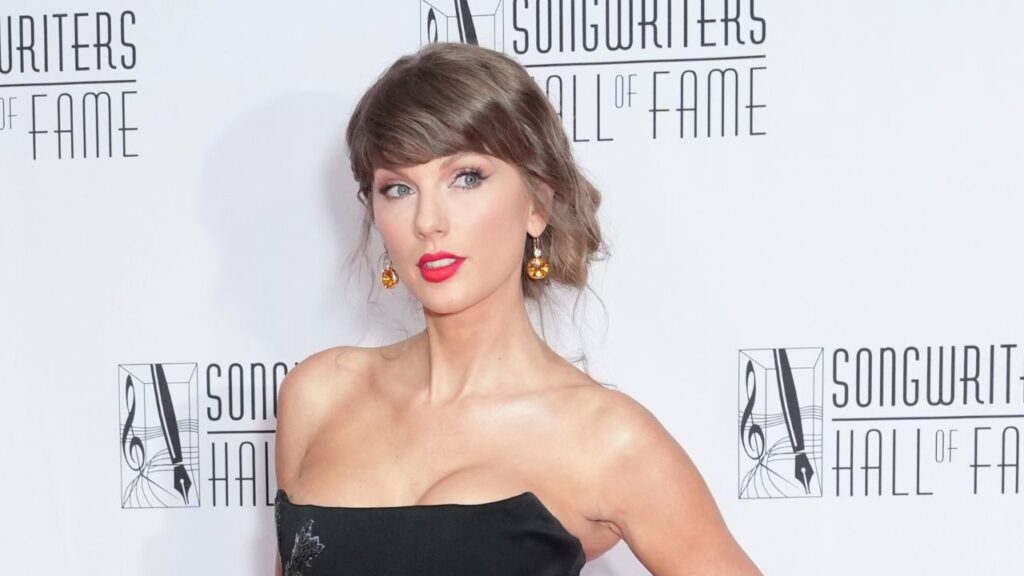
Taylor Swift has spent nearly two decades turning heartbreak, hope, insecurity and joy into songs that millions of people have claimed as pieces of their own lives. But standing on stage at the 2026 Songwriters Hall of Fame induction ceremony, the global superstar wasn’t interested in celebrating chart records or sold-out stadium tours. Instead, she pulled the curtain back on the messy, emotional, and often uncertain road that shaped her into one of the most influential songwriters of her generation.
During an emotional 21-minute speech delivered just after midnight at New York City’s Marriott Marquis Hotel, Swift spoke about family sacrifices, trusting instinct over industry trends, surviving criticism, and why songwriting has remained the easiest and truest part of her extraordinary career. It wasn’t a speech built around headlines. It felt more like a conversation between a songwriter and the people still listening to her stories after all these years.
Taylor Swift Says Songwriting Was Always the Easy Part
For someone whose career has unfolded under constant public attention, Swift admitted that very little about fame has actually been simple. Yet when she reflected on the highs and lows of her journey, one thing stood apart from everything else.
“It was easy to choose songwriting over everything else in my life,” Swift said.
That sentence became the emotional thread running through her speech. While she acknowledged the pressures that came with fame — industry battles, criticism, loss of privacy, and public scrutiny — she explained that writing songs had always felt instinctive rather than calculated.
“But when I say that songwriting was the easiest part for me, I think what I mean is that it was instinctual. No one taught me how to do it.”
Swift described herself as a child fascinated by stories, often rewriting melodies she heard in Disney films to fit events happening in her own life. Everything changed when she learned to play guitar at 12 years old. After mastering her first three chords, she wrote her first song.
For many artists, songwriting becomes a profession. For Swift, it sounded more like a language she naturally spoke before she fully understood what it could become.
The Family Decision That Changed Everything
One of the most touching moments of the evening arrived when Swift turned her attention toward the people who helped make her dream possible long before the world knew her name.
Success may have looked inevitable in hindsight, but she reminded the audience that it required enormous sacrifices from her family.
“But it couldn’t have been easy for my parents and my brother to just pick up and move our entire family from Pennsylvania to relocate to Nashville so that I could hone my craft in the songwriting capital of the world,” she said.
Swift continued, “But after making obvious that this was not even remotely a temporary phase their teen daughter was going through, they uprooted their entire lives to move me to Music City. And even though words are supposed to kind of be my thing, I will never be able to express my gratitude to you guys for doing that for me. You’re the reason I’m here tonight.”
The moment felt particularly significant because Swift’s career has often been framed through her achievements rather than the support system that helped build its foundation. On one of the biggest nights honoring her writing, she chose to spotlight the people standing beside her before any awards, headlines, or record-breaking tours existed.
Steven Spielberg, Kate Capshaw and a Lesson She’ll Never Forget
Another unexpected highlight involved filmmaker Steven Spielberg, who introduced Swift during the ceremony.
Swift revealed that when the Songwriters Hall of Fame asked who she would want to induct her, Spielberg’s name immediately came to mind because of the impact his storytelling had on her own imagination.
She recalled being stunned when he agreed to do it despite the release of his major new film, “Disclosure Day,” arriving just hours later.
Trying to give him an opportunity to decline, Swift joked about how impossible balancing both commitments seemed. That’s when Spielberg’s wife, Kate Capshaw, offered advice Swift says she will carry forever.
“Kate said something I’ll never forget. She said, ‘Good and true things are easy.'”
The phrase resurfaced throughout Swift’s reflections as she considered everything she’d endured over 23 years in the industry.
“And if I look back at my entire 23-year career in music, the ups and downs, the industry battles, the trials and tribulations, the tears and the cheers and the dogpiling of doubt, the criticism, both fair and unfair, the complete loss of privacy, the world tours and the ego wars and the twists of fate… songwriting was the easiest thing I ever did.”
It wasn’t because the work lacked effort. It was because, beneath the chaos, it remained true to who she was.
Why Taylor Swift Thinks Artists Need to Trust Themselves
One of the strongest sections of Swift’s speech centered around creativity in an era increasingly dominated by data, algorithms and predictions.
Reflecting on her early years in Nashville, Swift explained how seriously she treated co-writing sessions. She arrived prepared with notebooks full of hooks, half-finished choruses and lyrical concepts because she never wanted collaborators to believe she expected success to be handed to her.
She even shared a story involving acclaimed songwriter Craig Wiseman. During one writing session, she played him an unfinished song she deeply believed in. Wiseman wasn’t particularly drawn to it, and they moved on to something else.
Later that evening, Swift returned home and finished the song herself.
It eventually became “Love Story.”
The memory reinforced what she believes young writers need now more than ever: confidence in their own instincts.
“I think now more than ever, in an industry that seems to be consumed by metrics, data, analytics and we’re trying to predict whether something will trend or not, writers need to trust their human intuition.”
For Swift, numbers can inform decisions, but they can’t replace emotional truth. Songs that connect rarely emerge from spreadsheets.
Navigating Critics, Online Noise and an AI Era
Swift didn’t ignore the realities modern artists face.
She acknowledged the inevitability of criticism and encouraged younger creatives to develop resilience without sacrificing sensitivity. According to her, the challenge isn’t avoiding negativity altogether. It’s learning what deserves your attention and what doesn’t.
“You can be sensitive but also durable,” she said.
She also referenced the increasingly chaotic digital landscape, speaking about “the people who are chronically online or the robots posing as people who are chronically online.”
The comments drew attention because conversations around artificial intelligence and authenticity continue dominating the entertainment industry. Swift used the moment to champion human creativity, even praising performer Sombr and declaring that artists don’t need AI to make meaningful work.
For a songwriter whose lyrics have often served as emotional diaries for listeners, authenticity remains non-negotiable.
A Legacy Written Through Other People’s Lives
Perhaps the most moving part of the night came when Swift spoke about what legacy truly means to her.
Awards matter. Recognition matters. But the stories fans share matter more.
She talked about parents introducing their children to songs they once played during their own youth. She mentioned couples who adopted “Love Story” as their anthem and listeners who found comfort in tracks during difficult periods of their lives.
“Nothing delights and surprises me more than the fact that 20 years after my first song came out, they still wanna read the next chapter,” she said.
That may be the reason Swift’s acceptance speech resonated far beyond the ballroom where it was delivered. It wasn’t a victory lap celebrating celebrity status. It was a reminder that songs often outgrow their creators.
Some become battle cries. Some become memories attached to first loves and family road trips. Others simply help someone feel understood for three and a half minutes.
On a night dedicated to honoring songwriting, Taylor Swift reminded everyone why people keep coming back to hers. Behind the fame, controversies and cultural phenomenon is still a writer chasing the same feeling she had as a kid changing lyrics in the back seat of a car.
And after 23 years, she still believes the truest things are often the easiest to recognize.
*Source: Variety. Based on Taylor Swift’s full Songwriters Hall of Fame 2026 acceptance speech as provided in the uploaded file. *