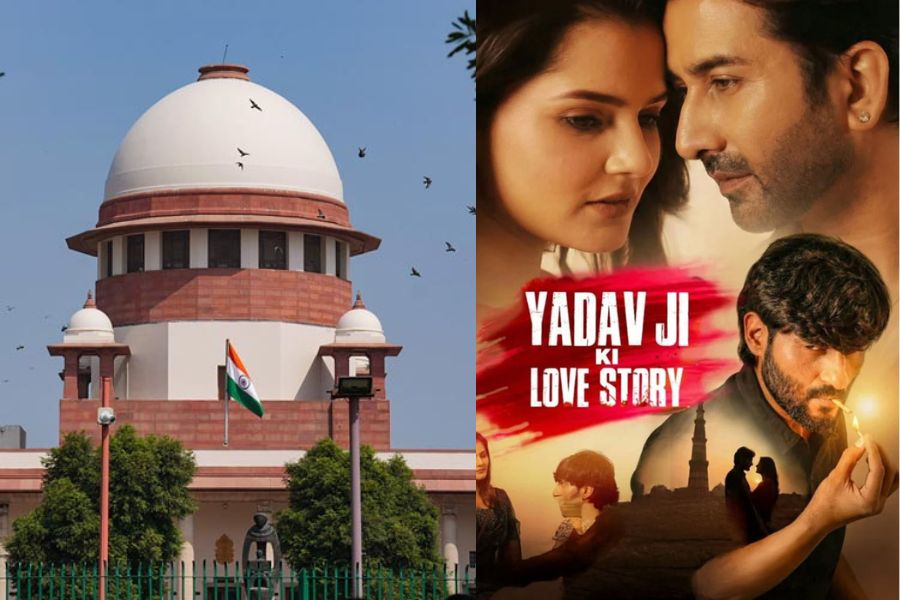
The controversy around Yadav Ji Ki Love Story has now reached a decisive legal turning point.
On Wednesday, the Supreme Court of India dismissed a petition seeking a ban or title change for the film, making it clear that the name does not portray the Yadav community in a negative light. With that ruling, the movie’s theatrical release on February 27 is back on track.
What Was the Objection?
The plea was filed by the chief of the Vishwa Yadav Parishad, who argued that the film’s title could reflect poorly on the Yadav community. The film reportedly revolves around a love story in which a Hindu girl marries a Muslim boy — a narrative that had already sparked debate in certain circles.
However, after examining the material placed on record, a bench comprising Justices BV Nagarathna and Ujjal Bhuyan found no merit in the argument.
Justice Nagarathna observed that the title does not contain any adjective or expression that casts the Yadav community in a bad light. The bench questioned how the mere naming of the film could harm the community’s image.
How This Differs From ‘Ghooskhor Pandat’
During the hearing, the bench also addressed comparisons with the earlier controversy surrounding Ghooskhor Pandat. In that case, the court had directed the producer to change the title because the word “ghooskhor” translates to “corrupt,” attaching a clearly negative meaning to a community.
In contrast, the judges noted that no such negativity is associated with Yadav Ji Ki Love Story. The court stated that none of the reasonable restrictions under Article 19(2) of the Constitution — which governs limits to freedom of speech and expression — were applicable in this case.
Calling the apprehensions “wholly unfounded,” the court dismissed the writ petition.
Court Calls It a Work of Fiction
The petitioner’s counsel argued that while inter-community marriages are not opposed, the portrayal of the woman in the film was problematic. But the bench remained unconvinced, categorising the movie as a work of fiction.
That distinction played a key role. Courts have often maintained that fictional narratives must be given creative space unless there is a direct and explicit violation of law.
The Bigger Context
In recent years, film titles and storylines touching on religion, caste, or community identity have frequently drawn legal scrutiny. From courtroom petitions to demands for bans, cinema continues to be a flashpoint in larger social debates.
However, this verdict reinforces the judiciary’s stance that not every perceived sentiment can override creative freedom — especially when no explicit derogatory content exists in the title itself.
Final Words
With the Supreme Court clearing the air, Yadav Ji Ki Love Story is set to release as scheduled on February 27.
The ruling not only settles the immediate controversy but also underlines a broader message: fictional storytelling cannot be curtailed based on assumptions alone.
For now, the film moves from courtroom headlines back to the big screen — where audiences will ultimately decide its fate.