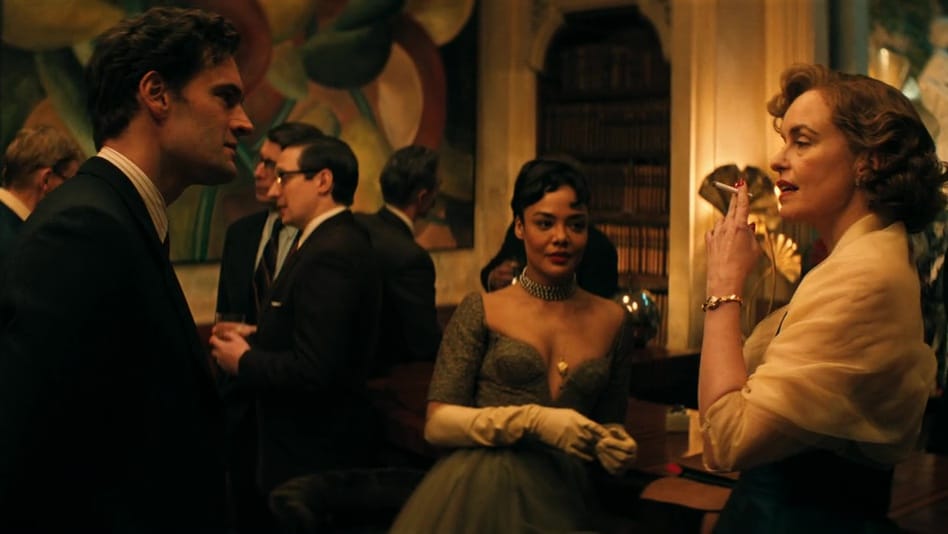
Hollywood star Tessa Thompson steps into one of the most complex female roles in literature with Hedda, a stylish, emotionally charged adaptation of Henrik Ibsen’s 1891 play Hedda Gabler. Directed by Nia DaCosta, the film reinterprets Ibsen’s psychological drama for a new generation — trading the Norwegian 19th century for postwar 1950s England, and adding layers of race, class, and gender to the story’s timeless exploration of repression and desire.
After its acclaimed world premiere at the Toronto International Film Festival 2025, Hedda is now streaming on Amazon Prime Video, where it’s being hailed as one of this season’s most intellectually riveting OTT releases.
🎭 Storyline: A Tale of Passion, Power, and Destruction
Hedda opens in a lavish English estate, where newlywed Hedda Gabler (Tessa Thompson) has just returned from her honeymoon with academic husband George Tesman (Tom Bateman). Despite the luxury that surrounds her, Hedda feels trapped — not just by marriage, but by society’s expectations of what a woman should be.
Her carefully controlled life begins to unravel when her former lover Eileen Lovborg (Nina Hoss) — a brilliant and independent woman in her own right — re-enters her world. What follows is a battle of intellect and emotion, manipulation and vulnerability, as Hedda’s yearning for control leads her down a tragic path of deceit and destruction.
DaCosta keeps the essence of Ibsen’s text intact but reinterprets it through a modern feminist and racial lens. By setting it in a post-war England still grappling with class hierarchy, the film finds new resonance in Hedda’s rebellion — not merely as an individual’s crisis but as a symbol of women defying societal molds.
⭐ What Worked
1. Tessa Thompson’s Towering Performance
Tessa Thompson is Hedda. Her portrayal captures the character’s contradictions — charming yet cruel, intelligent yet self-destructive. With minimal dialogue and a commanding screen presence, she embodies the quiet rage of a woman whose intellect and desire are suffocated by her surroundings. Her performance is layered and hypnotic, earning comparisons to Cate Blanchett’s Tár and Olivia Colman’s The Favourite.
2. Nia DaCosta’s Direction and Vision
DaCosta’s direction is both elegant and assertive. She merges period drama aesthetics with psychological intensity — combining candlelit grandeur, slow pans, and claustrophobic close-ups to mirror Hedda’s mental confinement. The 1950s setting adds cinematic richness, complete with crisp fashion, smoky parlors, and subtle post-colonial undertones.
DaCosta doesn’t shy away from risk. Her adaptation boldly explores interracial dynamics and gendered power without feeling heavy-handed. The result is a film that feels historical yet urgently modern.
3. Cinematography and Score
Shot by Sean Bobbitt (12 Years a Slave, The Place Beyond the Pines), the cinematography is exquisite — every frame feels like a painting, with deliberate contrasts of light and shadow mirroring Hedda’s dual nature.
The haunting score by Hildur Guðnadóttir (Joker, Chernobyl) deepens the tension, blending eerie strings with melancholy silences that amplify Hedda’s growing inner chaos.
4. Supporting Cast and Character Dynamics
Nina Hoss (as Eileen Lovborg) brings strength and elegance, transforming Lovborg into a worthy mirror and rival to Hedda’s ambition.
Imogen Poots offers empathy as Thea Clifton, while Nicholas Pinnock’s Judge Brack embodies the menace of patriarchy disguised as civility.
Their performances add emotional texture, grounding Hedda’s erratic choices in a believable web of social and psychological tension.
5. Themes That Resonate Today
The film powerfully captures the suffocating experience of women whose ambition and intelligence are punished by social norms. By giving Hedda a racial identity that diverges from her surroundings, DaCosta subtly reframes the narrative — her alienation becomes both personal and systemic.
In 2025, Hedda doesn’t feel like a relic — it feels like a mirror.
⚠️ What Didn’t Work
1. Over-Stylization at Times
While DaCosta’s visual style is stunning, it occasionally overshadows emotional intimacy. Some viewers may find the heavy symbolism — mirrors, candlelight, and long silences — too calculated, slowing the pacing during the middle act.
2. Script Compression
The adaptation condenses Ibsen’s intricate subplots, resulting in rushed character motivations near the end. The third act — Hedda’s psychological collapse — arrives so suddenly that it feels abrupt, leaving little room for reflection.
3. Distance from Emotion
DaCosta’s artistic restraint may leave some audiences emotionally detached. Unlike Greta Gerwig’s Little Women, which embraces warmth and passion, Hedda keeps its characters at arm’s length — beautifully cold, but undeniably distant.
💬 Critical Reception
- The Guardian praised it as “Ibsen meets Downton Abbey — elegant, provocative, and visually magnetic.”
- The New Yorker called it “a sharp, psychologically astute exploration of a woman’s undoing.”
- Audiences, however, appear divided: while critics admire its craft, casual viewers describe it as “beautiful but heavy,” a film that demands patience and emotional engagement.
🎞️ Final Verdict
Hedda is not an easy watch — it’s a slow burn that rewards attention. Nia DaCosta delivers a film that challenges, provokes, and mesmerizes in equal measure. It’s a fresh take on a 19th-century classic, reframed for the complexities of the 21st century.
At its heart lies Tessa Thompson’s haunting portrayal — one that lingers long after the credits roll.
⭐ Rating: 3/5
🎬 Streaming now on Amazon Prime Video
📺 Recommended for fans of psychological dramas, period films, and character-driven storytelling.