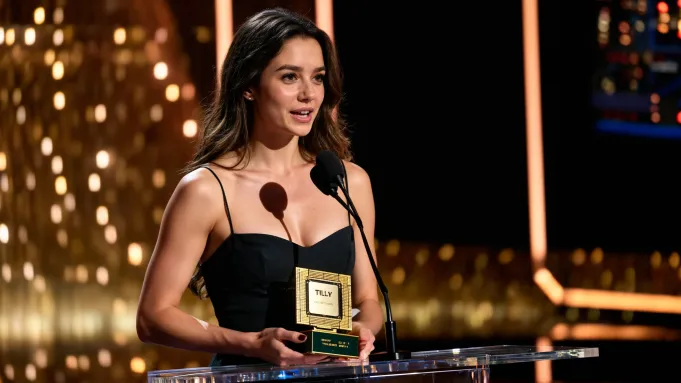
The announcement of an AI-generated actress landing a lead role in a feature film has once again divided Hollywood. Tilly Norwood, a digital character created by London-based AI studio Particle 6, is set to headline Misaligned, a comedy-drama currently in production. While the project is being presented as an experiment showing how artificial intelligence can work alongside human filmmakers, it has also reopened concerns about copyright, performer rights and whether AI-generated actors belong in the entertainment industry at all.
Instead of celebrating a technological milestone, the news quickly triggered another wave of criticism across social media and within creative circles. Many questioned why an AI-generated performer should be treated like a real actor, while others raised familiar concerns about how today’s AI systems are trained. The conversation has once again shifted beyond one project and toward the much bigger question facing the film business: where should Hollywood draw the line between innovation and human creativity?
Particle 6 says the project is about education, not replacement
Particle 6 founder and CEO Eline van der Velden believes much of the criticism misses the point of what the studio is trying to achieve. According to her, Misaligned is designed to show filmmakers where AI technology currently stands while encouraging industry professionals to learn how to work with it instead of fearing it. The production itself will combine human cast and crew members with AI-powered creative tools rather than replacing every role with automation.
Speaking about the response following the announcement, van der Velden said, “More people than ever before are hearing and understanding that message. And if we can get more people working in AI and future-proofing their roles, a little criticism won’t matter.” She added that interest from creative professionals has increased since the project became public, suggesting that curiosity about AI filmmaking continues to grow despite the backlash.
The company also insists Tilly Norwood was not modelled after any specific individual. According to van der Velden, the digital character was created through original prompting, thousands of creative iterations and extensive human supervision while using publicly available AI tools. She further clarified that Tilly will only appear in AI-created productions rather than films featuring live actors.
Unions and industry groups remain deeply concerned
Despite Particle 6’s explanation, many organisations representing actors and filmmakers remain unconvinced. One of the biggest concerns continues to revolve around the datasets used to train modern AI systems. Critics argue that many AI models have learned from creative works uploaded online without obtaining permission from the artists who originally created them.
The U.K. performers’ union Equity said in a statement that, “When it comes to the use of AI avatars — whether that’s ‘Tilly Norwood’ or any others — there are concerns about how a digital replica or avatar was created.” The union believes transparency, consent and fair payment remain essential if AI is to become part of film, television and audio production in a responsible way.
Cathy Sweet, Equity’s Head of Film and TV, also warned about the wider issue surrounding AI training data. She said, “While data scraping and untraceable training data sources continue, the questions of theft and misuse will persist. Actors, voice artists and performers of all kinds are left vulnerable to their work being stolen and used without their consent or even knowledge. This isn’t OK and it has to stop.” Those concerns echo arguments made throughout Hollywood during recent negotiations over AI protections.
Similar criticism has also come from the Creators Coalition on AI. Interim executive director Ted Tremper argued that Tilly Norwood cannot truly be considered a performer because the character represents a collection of creative work produced by countless people whose contributions may never be recognised or compensated. According to Tremper, the real discussion should focus on whether the human creators whose work helped train AI systems receive proper respect, transparency and payment.
Hollywood is still searching for the right balance
The debate surrounding Tilly Norwood arrives at a time when nearly every major entertainment company is trying to understand where generative AI fits into future productions. While some studios are actively experimenting with AI-assisted visual effects, scripting and production workflows, others remain extremely cautious because of legal uncertainty and public perception.
Major Hollywood organisations have largely avoided embracing AI performers. The Writers Guild of America and the Directors Guild of America did not publicly comment on the latest announcement, while SAG-AFTRA has previously described Tilly Norwood as “the synthetic construct generated by software trained on the work of countless professional performers, real human beings, whose work was taken without permission, without credit and without compensation.” That position reflects the union’s ongoing campaign for stronger AI protections following the 2023 labour negotiations.
Even talent agencies have shown little interest in representing an AI-generated personality. According to Particle 6, conversations with agencies ended last year because the company currently sees no need for representation. Several industry executives have also questioned how an artificial character could be managed in the same way as a human performer.
Not everyone believes AI actors should be rejected forever. Ted Tremper acknowledged there could eventually be a future where synthetic performers exist alongside human talent if creators whose work contributes to these systems receive proper compensation and meaningful consent. He argued that such a future would require genuine collaboration rather than treating AI adoption as something inevitable.
Animation veteran Chris Meledandri, CEO of Illumination, also offered a cautious perspective while discussing AI’s growing role in filmmaking. He said, “We’re complete believers in the human imagination” and added that his studio currently feels “no pressure to push AI into our pipeline.” While acknowledging that artificial intelligence will continue evolving, he also admitted uncertainty about what it could mean for creative jobs across the entertainment business.
For now, Misaligned has become much more than another independent film announcement. Whether audiences eventually embrace Tilly Norwood or reject the idea entirely, the project has already reignited one of Hollywood’s biggest conversations. As AI technology continues advancing, debates around ownership, creativity and the value of human artistry are only becoming louder.