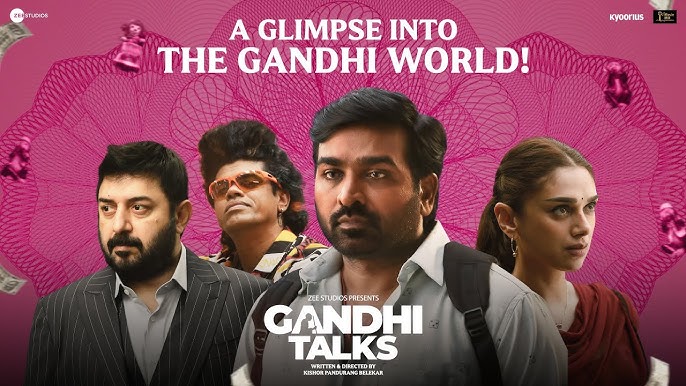
In an era dominated by loud dialogues and instant gratification, Gandhi Talks arrives like a quiet rebellion. Directed by Kishore Pandurang Belekar, the film, which released in cinemas on January 30, dares to tell its story without spoken words—relying instead on images, expressions, and music to communicate what most films spell out loudly.
Premiered earlier at the International Film Festival of India in 2023, Gandhi Talks finally meets a wider audience, asking viewers to slow down and truly watch.
The Story
At the heart of Gandhi Talks are two men from opposite ends of society.
Arvind Swami plays Mohan Boseman, a once-powerful real estate tycoon whose life has steadily collapsed under the weight of personal loss and moral decay. Isolated and stripped of control, he waits in a large, empty home that mirrors his inner desolation.
On the other side is Vijay Sethupathi, portraying a man barely surviving in Mumbai, carrying the burden of poverty and a sick mother. A chance accident destroys his hard-earned money, pushing him toward rage and desperation. That single moment becomes the thread that pulls both men into the same space—Boseman’s house—where anger slowly transforms into reflection.
What follows is not a confrontation filled with shouting, but a quiet moral reckoning shaped by glances, pauses, and silence.
Performances & Direction
Vijay Sethupathi delivers one of his most restrained performances. He communicates pain, frustration, and helplessness through stillness rather than movement, trusting the audience to read what remains unspoken.
Arvind Swami is equally compelling, portraying a man accustomed to power now grappling with emptiness. His gradual emotional unravelling feels controlled, never theatrical.
Aditi Rao Hydari brings emotional balance to the narrative, grounding the film with sensitivity and warmth, while Siddharth Jadhav uses expressive reactions to add texture to the story.
Director Kishore Pandurang Belekar shows remarkable confidence by letting scenes breathe. He doesn’t rush emotions or over-explain moments, allowing silence to become a language of its own.
Music as the Film’s Voice
In a film without dialogue, music becomes everything—and A. R. Rahman rises to the challenge. His score acts as the film’s emotional spine, guiding transitions, heightening tension, and sometimes deepening silence instead of filling it.
Rather than overpowering the visuals, Rahman’s music listens—responding to the characters’ inner worlds and amplifying what they cannot say aloud.
What Works / What Doesn’t
What works:
- A bold silent-film approach in modern cinema
- Deeply controlled performances
- AR Rahman’s immersive, story-driven score
- Strong visual storytelling supported by cinematography and editing
What doesn’t:
- The pacing may feel slow or stretched for some viewers
- Requires patience and full attention—this is not a casual watch
Final Verdict
Gandhi Talks isn’t designed to entertain in the conventional sense—it’s meant to be experienced. Its silence may test patience, but its sincerity and ambition leave a lasting impact. The film explores vulnerability, privilege, and morality without handing out easy answers.
For audiences open to unconventional storytelling, Gandhi Talks stands out as a brave cinematic experiment—one that proves silence, when used right, can speak louder than words.