A dragon appears… but not the way you think
About halfway through the pilot of A Knight of the Seven Kingdoms, a dragon finally shows up. It breathes fire, looks menacing, and commands attention — only for the reveal to land like a wink. It’s not a real dragon at all, but a cleverly built puppet entertaining onlookers at a knightly tournament.
And just like that moment, HBO’s latest Game of Thrones spinoff makes its mission clear: this isn’t about bigger dragons, louder politics, or sprawling maps. This is a quieter, more intimate, surprisingly funny detour into Westeros — and it works far better than expected.
A deliberately smaller Westeros
After the maximalist approach of House of the Dragon, A Knight of the Seven Kingdoms feels refreshingly restrained. The entire season largely revolves around one tournament, a handful of noble houses, and a tightly contained six-episode arc. No globe-trotting politics. No endless family trees. No armies marching across the map.
Instead, creators George R. R. Martin and Ira Parker adapt Martin’s Dunk and Egg novellas into something closer to a hangout adventure than an epic saga. Think Westeros through a human-scale lens — almost like a medieval road movie with swords.
The heart of the show: Dunk and Egg
At its core, this is a two-hander — and a charming one.
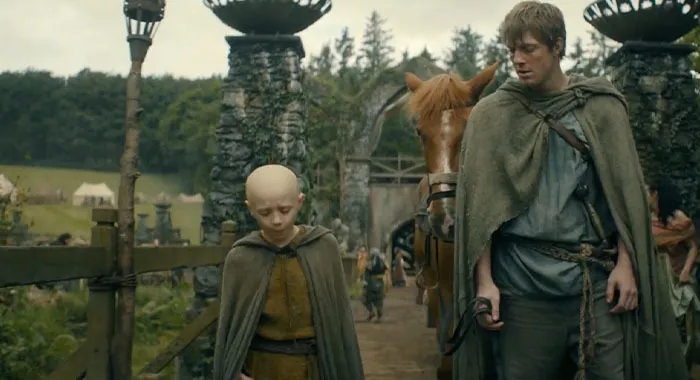
Peter Claffey plays Duncan (Dunk), a towering former squire who has just lost the only father figure he’s ever known, hedge knight Ser Arlan. All Dunk is left with are three horses, a battered shield, a sword, and a questionable claim that he was knighted before his mentor died.
Enter Egg — played by Dexter Sol Ansell — a bald, sharp-tongued boy who insists on becoming Dunk’s squire. Their dynamic is instantly winning: Dunk is earnest, slow-speaking, and physically imposing; Egg is quick, clever, and endlessly curious. Together, they stumble toward a tournament that promises money, recognition, and a slim chance at legitimacy in a world stacked against low-born men.
Their banter — about knighthood, songs, ambition, and survival — is where the show truly shines.
Royal shadows and tournament chaos
The tournament itself brings familiar Westerosi power into the frame. It’s overseen by Baelor Targaryen, played with calm authority by Bertie Carvel, alongside his volatile brother Prince Maekar (Sam Spruell). Their presence reminds us that even in a “small” story, the Iron Throne’s shadow looms large.
Around them orbit drunk knights, scheming nobles, servants, sex workers, and Tanselle — a Dornish puppeteer whose dragon act becomes unexpectedly central. Performances from Daniel Ings as the boisterous Ser Lyonel Baratheon add bursts of anarchic energy to the proceedings.
When fun gives way to blood
For much of its early stretch, A Knight of the Seven Kingdoms plays like a cheeky, self-aware riff on the franchise. There’s broad humor, bodily jokes, and even playful disrespect toward Westerosi mythology. When Ramin Djawadi’s iconic theme kicks in — only to be undercut by crude visual gags — the show makes it clear it’s not reverent for reverence’s sake.
But this is still Westeros.
As the tournament escalates, the story darkens. The humor thins out. Violence becomes more explicit. The legal brutality of the realm asserts itself, and bodies start dropping. While effective, this tonal shift slightly dulls the show’s earlier magic. The series is at its best when it’s letting Dunk and Egg wander, talk, and bond — not when it’s ticking off grim franchise expectations.
Direction, visuals, and grounded scale
Directors Owen Harris and Sarah Adina Smith ensure the show never feels cramped despite its limited scope. Shot in Northern Ireland, the series uses rolling hills, diagonals, and natural light to remind viewers that spectacle doesn’t always require CGI dragons.
The combat is brutal and unglamorous — visceral enough to feel dangerous, not operatic. It reinforces the idea that knighthood is more about survival than glory.
Performances carry the crown
While the supporting cast is solid, the emotional weight rests squarely on Claffey and Ansell. Claffey’s Dunk is vulnerable beneath his size, a man learning what honor actually costs. Ansell’s Egg is mischievous, observant, and quietly heartbreaking in his yearning to matter.
Their chemistry feels effortless — rare for a pairing this inexperienced — and it’s the single biggest reason the series works.
Final Verdict
A Knight of the Seven Kingdoms proves that less really can be more. By stripping away dragons, politics, and endless lore dumps, HBO has delivered one of the most approachable, character-driven entries in the Westeros franchise.
It stumbles slightly when it leans too hard into grim tradition, but its humor, heart, and central duo more than make up for it. This isn’t a replacement for Game of Thrones — it’s something gentler, smarter, and oddly more human.
If this is the future of smaller, story-first spinoffs, Westeros might finally be learning from its past.